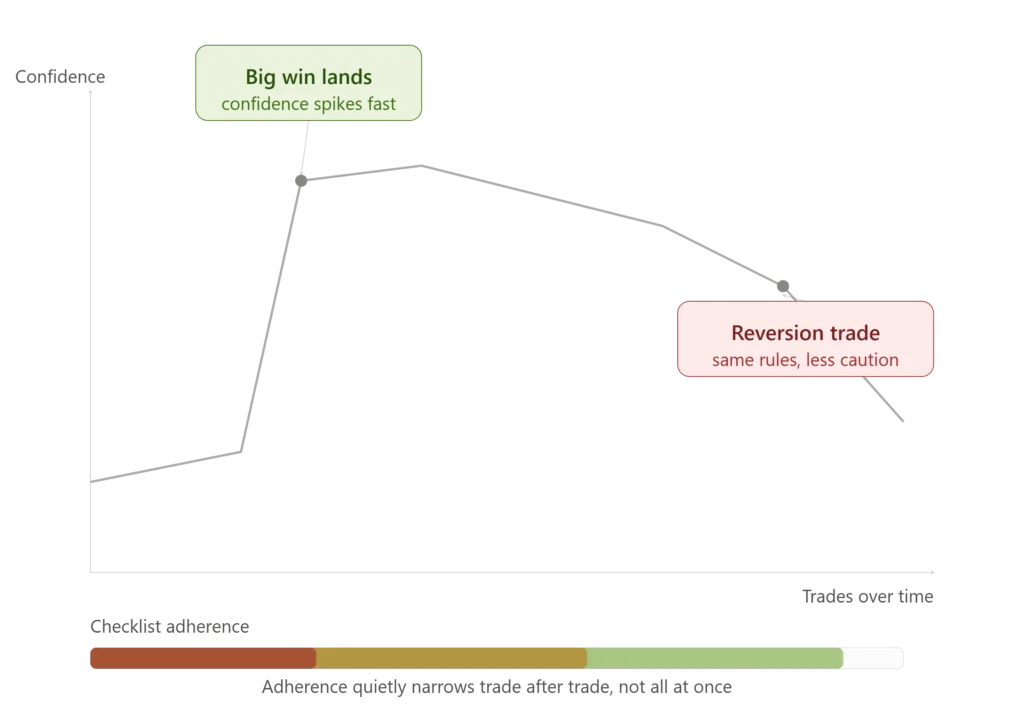
Nobody sits down after a great trade and consciously decides to start cutting corners. That is part of what makes this pattern so hard to catch. Overconfidence following a win does not arrive as a decision. It arrives as a gradual loosening, one small deviation at a time, each one feeling minor and justified in isolation, until several trades later the process looks nothing like the one that produced the win in the first place.
I want to walk through why this happens, because I think most trading psychology advice treats overconfidence as an obviously identifiable state, something you would notice if you were paying attention. In practice, it is closer to a slow drift than a sudden shift, and the drift is specifically hard to notice because each individual step away from your usual discipline can be defended on its own terms.
Why a big win changes your baseline, quietly
A strong, well executed trade does something psychological that is easy to underestimate. It does not just produce a gain. It recalibrates, even briefly, your internal sense of how reliable your own judgment is right now. This is not entirely irrational. A trade that worked well genuinely does contain useful information about your process. The problem is that the recalibration tends to overshoot, applying a general sense of increased confidence to decisions that have nothing to do with the specific setup that actually worked.
The trade that won might have had a particularly clean pattern, a well confirmed entry, a favorable risk to reward that was calculated properly in advance. The lesson from that trade, if there is one, is specific to those conditions being present. What tends to happen instead is a broader, less specific confidence boost, a sense that your reads are good right now, that gets applied to the next several trades regardless of whether those trades actually meet the same bar.
The first deviation always looks reasonable
Overconfidence rarely shows up as an obviously reckless decision right after a win. It shows up as a small adjustment that would have felt unreasonable a week earlier but now feels like a natural extension of good judgment. Maybe the position size on the next trade is slightly larger than usual, justified internally as simply having more confidence in this particular setup. Maybe an entry gets taken without waiting for the full confirmation criteria, because the last few reads have been good and waiting feels like unnecessary caution rather than actual discipline.
Each of these, taken alone, is defensible. A slightly larger position size is not automatically reckless. Skipping one confirmation step on one trade is not automatically catastrophic. The danger is not in any single deviation. It is in the fact that these deviations tend to compound, each one making the next one feel more normal, until the process several trades later bears only a loose resemblance to the one that actually produced the original win.
Why the checklist stops functioning as a checklist
A trading checklist only works if it is applied the same way regardless of recent results. The moment it starts being treated as a suggestion to be adjusted based on how you are feeling, it stops functioning as the thing it was designed to be, a fixed standard that exists specifically to override your in the moment judgment. Overconfidence does not usually announce itself by abandoning the checklist entirely. It shows up as selective application, still going through the motions of checking the criteria, but with a lowered bar for what counts as a pass.
This is genuinely hard to notice from the inside, because the checklist is still technically being used. The entries in your trading journal might even look similar to how they looked before the winning trade. But the actual threshold for what qualifies has shifted, quietly, in a direction that favors action over patience, without that shift ever being consciously decided.
Why the next loss after a win tends to feel disproportionate
There is a specific and somewhat cruel pattern that tends to follow this kind of drift. The trade that finally reveals the loosened standard, the one that would not have qualified under the original discipline, tends to lose in a way that feels disproportionate to how it was entered. It rarely feels like a single obviously bad decision in the moment. It feels like a reasonable extension of a good run that simply did not work out this time.
This matters because it affects how the loss gets processed afterward. A single, obviously reckless trade tends to get flagged immediately as a mistake and corrected quickly. A loss that emerged gradually, through a series of individually small deviations, is harder to diagnose cleanly, because there is no single decision to point to as the clear cause. The temptation is to treat it as bad luck, an otherwise sound process that simply ran into an unfavorable outcome, when the more accurate read is that the process itself had already shifted several trades earlier.
Why success is actually a worse teacher than failure, in this specific way
Losses tend to trigger genuine self examination. There is real discomfort attached to losing money, and that discomfort creates pressure to understand what happened and correct it. Wins do not create the same pressure. A winning trade feels complete and resolved, and the natural instinct afterward is to carry that feeling of competence forward rather than interrogate whether the specific conditions that produced the win are actually present in the next setup.
This creates an uncomfortable asymmetry. The trades most likely to expose flaws in your process, the losses, get reviewed carefully. The trades most likely to quietly erode your process, the wins that lead to gradually loosened standards afterward, tend to get the least scrutiny of any category, precisely because they feel like validation rather than a warning sign.
What actually helps here
The fix is not suppressing confidence after a good trade, which is not a realistic goal and probably not even a desirable one. Confidence built on a genuinely well executed trade is useful information. The fix is separating that confidence from your actual entry criteria, treating them as two entirely different things that should not be allowed to influence each other.
In practice, this means holding the next several trades after any strong win to the exact same standard you would apply on a normal day, deliberately, rather than assuming your recent form justifies any adjustment. It can help to physically review your checklist criteria immediately before the next entry after a big win, specifically because that is the moment the bar is most likely to have shifted without your noticing. Position sizing decisions in particular deserve extra scrutiny in this window, since size increases driven by recent success rather than the actual risk profile of the current trade are one of the most common ways this pattern shows up.
Why this deserves its own category, separate from FOMO
It is worth being clear that this is a different mechanism from FOMO, even though the end result, an entry that should not have qualified, can look similar. FOMO is driven by fear of missing a specific opportunity in front of you right now. Overconfidence after a win is driven by an inflated sense of your own recent judgment, applied broadly to decisions that have nothing to do with the trade that actually earned that confidence. Treating them as the same problem risks missing the specific trigger for each one, and the trigger for this pattern is success itself, which makes it considerably harder to build a defense against than a fear based mistake.
The honest version of managing this is accepting that a win, especially a clean, well executed one, is not just a gain to bank and move past. It is a moment that specifically requires more discipline in the trades that immediately follow it, not less, precisely because that is when the internal pressure to maintain your usual standards is at its weakest.