Twice every quarter, the Indian stock market goes through one of its busiest periods. Companies release their quarterly results, analysts update their estimates, brokerages revise target prices, and investors reassess their expectations. For long-term investors, earnings season is an opportunity to evaluate the health of a business. For swing traders, it offers something different: a fresh set of stocks that can potentially trend for several weeks.
Not every company that reports strong numbers becomes a winning trade. Likewise, not every stock that gaps up after earnings continues its upward journey. Some reverse sharply within days, while others spend weeks moving sideways before resuming their trend. The challenge is separating temporary excitement from genuine institutional buying.
This distinction matters because some of the strongest swing trades in the Indian market have begun after quarterly earnings. Stocks such as Dixon Technologies, Trent, Bharat Electronics, Persistent Systems, HAL, CG Power and KPIT Technologies have, at different points, delivered exceptional results, attracted institutional interest and gone on to produce sustained price trends. The opportunity was rarely in predicting the earnings surprise. It was in recognising how the market responded after the numbers were out.
Earnings Don’t Move Stocks. Expectations Do.
A quarterly result is only meaningful in the context of what the market was expecting.
If a company reports a 25% increase in profit but investors were already expecting 35%, the stock may fall despite reporting healthy growth. On the other hand, a company delivering numbers well ahead of expectations can see an immediate re-rating, even if the absolute growth rate appears modest.
This is why experienced traders pay as much attention to the market’s reaction as they do to the financial statements themselves.
The day after results, the price action reflects thousands of participants processing the same information. Analysts revise earnings models, institutional investors adjust their portfolios and market participants decide whether the company’s future prospects have improved. That collective response often provides a clearer signal than the earnings report alone.
Why Chasing the Gap-Up Is Rarely the Best Trade
One of the most common mistakes during earnings season is buying a stock simply because it opens significantly higher.
The logic seems straightforward. If the company has reported excellent numbers and the stock has already gained 10%, it must be heading even higher.
Markets rarely work that neatly.
A sharp gap-up attracts momentum traders, profit booking from existing investors and short-term volatility. It is common to see a stock spend several sessions digesting those gains before deciding its next direction.
Buying into the first wave of excitement often leaves little room for error. Even if the broader trend remains intact, a normal pullback can test a trader’s conviction and force an early exit.
Waiting for the initial volatility to settle is often a more disciplined approach. Strong companies rarely offer only one opportunity to participate. If institutional demand is genuine, it usually becomes visible over multiple trading sessions rather than a single day.
Understanding Institutional Accumulation
Retail traders and institutions participate in the market very differently.
An individual investor can purchase ₹5 lakh worth of shares in a matter of seconds. A domestic mutual fund or foreign institutional investor looking to deploy ₹300 crore into a company cannot.
Large orders are accumulated gradually to avoid moving the market against themselves. This creates a characteristic pattern that appears repeatedly across different stocks and sectors.
The sequence usually looks something like this:
- A company reports results significantly ahead of expectations.
- The stock gaps up on unusually high volume.
- Instead of collapsing, it holds on to most of its gains.
- Over the next several sessions, price moves sideways while trading activity gradually declines.
- Once selling pressure is absorbed, the stock resumes its uptrend with fresh volume.
This process often reflects institutions building positions rather than speculative buying alone.
While no chart can definitively reveal who is buying, sustained price strength supported by above-average volume is one of the clearest indications that larger market participants remain interested.
Gland Pharma: Earnings Gap Followed by Institutional Accumulation
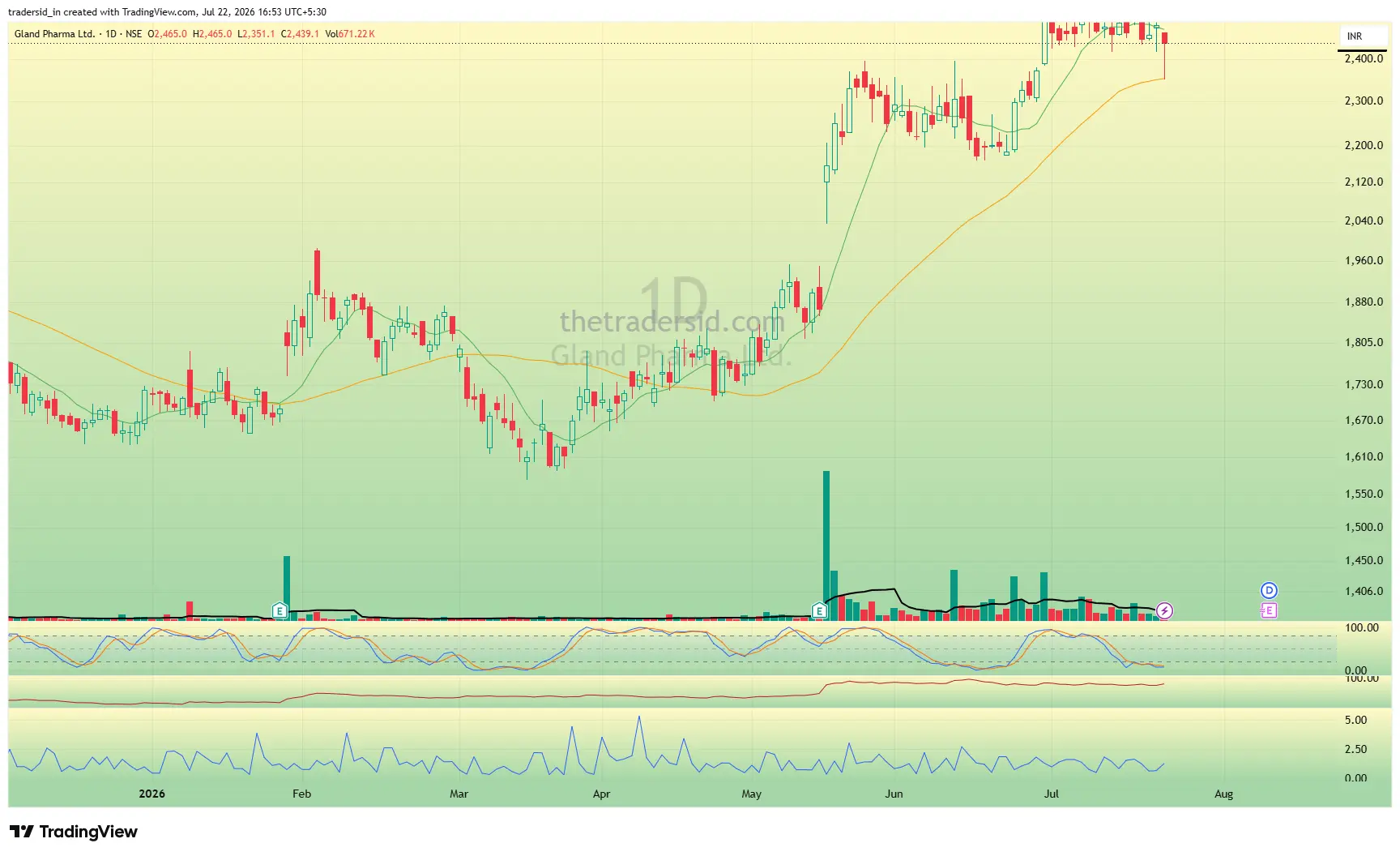
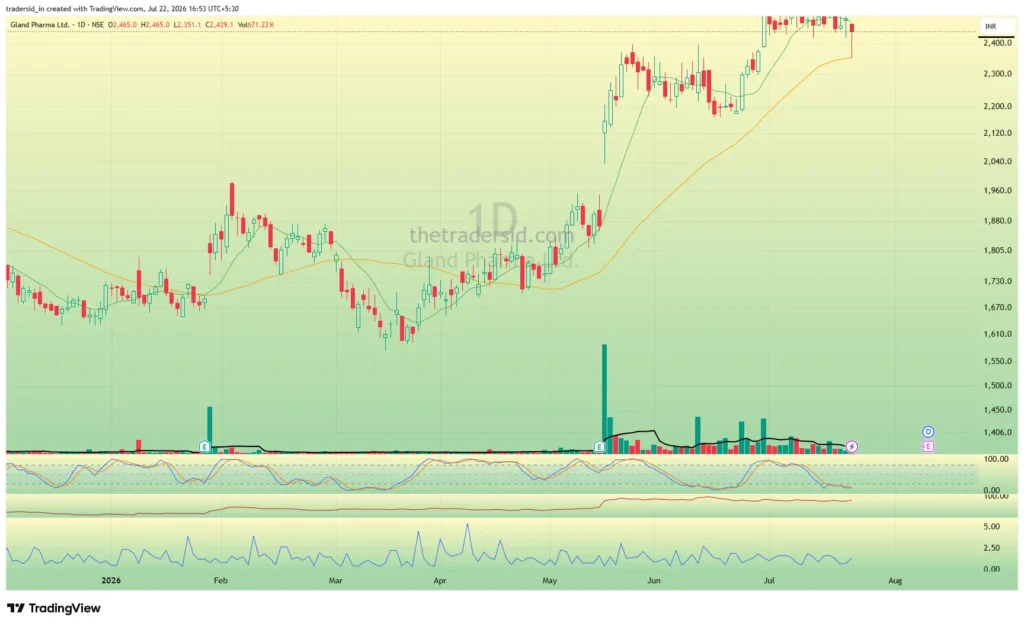
The daily chart of Gland Pharma illustrates one of the cleanest examples of an earnings-driven breakout. After spending several months in a broad trading range between ₹1,650 and ₹1,900, the stock was repriced sharply following its quarterly earnings announcement in May 2026. A significant gap-up on exceptionally high trading volume marked the beginning of a new trend rather than the end of one.
Instead of giving back its gains over the following sessions, Gland Pharma entered a healthy consolidation above the gap, indicating that selling pressure was being absorbed without damaging the newly established uptrend. Once this consolidation was complete, buyers regained control and the stock resumed its advance, eventually climbing towards ₹2,550.
The chart demonstrates an important principle of momentum trading: the earnings gap is the catalyst, but the consolidation that follows often provides the higher-probability entry.
Breaking Down the Chart
1. The Gap-Up Repriced the Stock Overnight
The most striking feature of the chart is the large gap-up that appears in the second half of May. Instead of opening near the previous day’s closing range, Gland Pharma opened almost ₹250 to ₹300 higher, leaving a clear gap between the prior session’s high and the next day’s opening price.
Markets rarely produce moves of this magnitude without fresh information. In this case, the earnings announcement fundamentally changed how investors valued the company. Rather than negotiating gradually through every price level, buyers immediately accepted a substantially higher valuation.
For traders, this is the first signal that the market may be reassessing the company’s future earnings potential.
2. Volume Confirmed That the Move Was Broad-Based
Price alone is not enough.
Beneath the gap-up candle sits one of the largest volume bars on the entire chart. Such a sharp increase in trading activity suggests that participation extended well beyond retail traders.
Large institutions cannot build meaningful positions quietly. While no chart can identify individual buyers, unusually high turnover following strong earnings often indicates that institutional investors are actively adjusting their exposure.
This is one of the reasons volume deserves as much attention as price during earnings season.
3. The Market Accepted the New Price
Many earnings gaps fail because traders quickly sell into the initial enthusiasm.
That did not happen here.
Over the following weeks, Gland Pharma remained comfortably above the earnings gap. Although the stock experienced normal day-to-day fluctuations, it never surrendered the majority of its gains.
This behavior is significant. Markets often reveal their conviction not through the size of the first move but through their ability to defend it.
4. Consolidation Created the Opportunity
Once the excitement faded, the stock moved sideways.
To many traders, this period appeared uneventful. In reality, it was one of the healthiest phases of the entire trend.
The candles became smaller, volatility reduced, and the 20-day exponential moving average steadily caught up with price. Rather than collapsing, the stock spent several weeks absorbing supply while remaining above the earnings gap.
This type of consolidation frequently acts as the foundation for the next advance.
5. The Trend Resumed
Towards the end of June, buyers once again became aggressive.
The stock broke above its consolidation range with improving momentum and continued its move towards fresh highs.
By this stage, the market had effectively confirmed that the earnings announcement was not a one-day event. It had become the beginning of a sustained trend.
What the Chart Teaches
Gland Pharma highlights several characteristics that frequently appear in successful earnings breakouts.
- A meaningful earnings surprise triggers a sharp gap-up.
- Trading volume expands dramatically, suggesting broad participation.
- The stock holds its gains instead of immediately filling the gap.
- A period of consolidation allows the market to absorb profit booking.
- The next breakout often provides a cleaner entry than the earnings day itself.
Not every earnings gap will develop this way. Some fail within days, while others drift sideways for months. The objective is not to predict which gap will succeed but to recognise the relatively small number that display these characteristics consistently.
Building an Earnings Watchlist
Preparation begins before the market reacts.
- During every earnings season, maintain a calendar of companies scheduled to announce results. The objective is not to predict surprises but to monitor the stocks that deserve closer attention once the numbers are released.
- After each announcement, focus on two separate questions.
- First, were the results genuinely strong relative to expectations?
- Second, did the market reward those results?
Many traders spend considerable time analysing financial statements while ignoring the chart. Others look only at price action without understanding what drove the move.
Both perspectives are incomplete.
The highest quality opportunities usually emerge when improving business fundamentals are confirmed by constructive market behaviour.
Looking Beyond Revenue and Profit Growth
Quarterly earnings involve much more than headline numbers.
Revenue growth and net profit provide an initial indication of business performance, but they rarely tell the complete story.
Several other factors deserve equal attention.
- Has operating margin improved?
- Has management upgraded its guidance for the coming quarters?
- Has the order book strengthened?
- Is working capital improving?
- Has debt reduced?
- Are export markets recovering?
For manufacturing businesses, capacity expansion and utilisation often matter as much as profit growth. For IT companies, commentary on deal wins and client spending can shape future expectations. Banks require close attention to asset quality, credit growth and net interest margins.
Understanding what drives each sector helps distinguish a genuinely strong quarter from one supported by one-off factors.
Volume: The Market’s Confirmation Signal
Price attracts attention.
Volume provides context.
A stock rising 8% on average trading activity may simply reflect short-term enthusiasm. The same move accompanied by three or four times its normal volume carries greater significance.
High volume suggests that participation extends beyond retail traders. Large investors leave footprints through sustained trading activity because building meaningful positions takes time.
Volume should not be viewed as an independent trading signal. However, when combined with strong earnings and constructive price action, it significantly improves confidence in the setup.
Waiting for the Base to Develop
One of the least appreciated phases of an earnings breakout occurs after the excitement has faded.
Strong stocks rarely move vertically for extended periods. Instead, they pause.
This consolidation serves an important purpose. Early buyers book profits, momentum traders exit and weaker hands lose patience. Meanwhile, continued institutional demand absorbs available supply without allowing the price to deteriorate significantly.
Healthy consolidations share several common characteristics.
- The trading range becomes tighter.
- Daily candles become smaller.
- Volume gradually declines.
Support develops around short-term moving averages or previous breakout levels.
Rather than viewing this inactivity as weakness, traders should recognise it as evidence that the market is accepting the new price range.
Timing the Entry
The ideal entry rarely coincides with the earnings announcement itself.
Instead, it appears once the consolidation is complete and buyers regain control.
A breakout above the consolidation range accompanied by expanding volume indicates that demand continues to outweigh supply.
Waiting for this confirmation may result in buying at a slightly higher price. However, it often reduces the probability of entering a failed breakout.
Successful trading is less about buying at the absolute lowest price and more about participating in trends with favourable probabilities.
The Role of the Broader Market
No stock trades in isolation.
Even fundamentally strong companies can struggle if the broader market enters a correction.
Before committing capital, it is worth assessing whether the overall environment supports momentum trades.
Questions worth asking include:
- Is the Nifty 50 trading above its medium-term trend?
- Is the relevant sector outperforming the broader market?
- Are mid-cap and small-cap indices showing healthy participation?
- Are recent breakouts succeeding or failing?
A favourable market backdrop improves the probability that earnings momentum will continue.
Common Mistakes During Earnings Season
Several recurring mistakes reduce the effectiveness of this strategy.
The first is confusing a good company with a good trade. A fundamentally strong business purchased at the wrong time can still produce disappointing results.
The second is chasing extended price moves immediately after a large gap-up. By the time retail enthusiasm peaks, much of the easy move has often already occurred.
Another common mistake is relying exclusively on earnings growth while ignoring price action. Markets occasionally reject strong results because expectations were even higher.
Finally, many traders overlook position sizing. Earnings-related trades can be volatile, and even well-researched ideas occasionally fail. Limiting risk on every position remains essential regardless of conviction.
A Repeatable Process
Perhaps the greatest advantage of earnings season is that it repeats every quarter.
Rather than searching for random chart patterns throughout the year, traders can focus on a structured process.
- Monitor the earnings calendar.
- Identify companies delivering meaningful business improvements.
- Observe how the market reacts.
- Build a watchlist.
- Wait for constructive consolidations.
- Enter only after price confirms continued demand.
The process is straightforward. Executing it consistently requires patience.
Final Thoughts
Quarterly earnings are among the few events capable of changing the market’s perception of a business in a meaningful way. They create fresh information, attract institutional participation and often establish new leadership for the months ahead.
The opportunity, however, does not lie in predicting which company will report outstanding numbers or in rushing to buy the first gap-up after the announcement. It lies in understanding how professional money behaves once the initial excitement subsides.
For swing traders in the Indian cash market, the objective should be to identify businesses where improving fundamentals and constructive price action reinforce each other. Strong earnings provide the catalyst. Institutional accumulation provides the fuel. Patience provides the edge.
When these elements align, the resulting trends can last far longer than the earnings announcement that first brought the stock into focus.