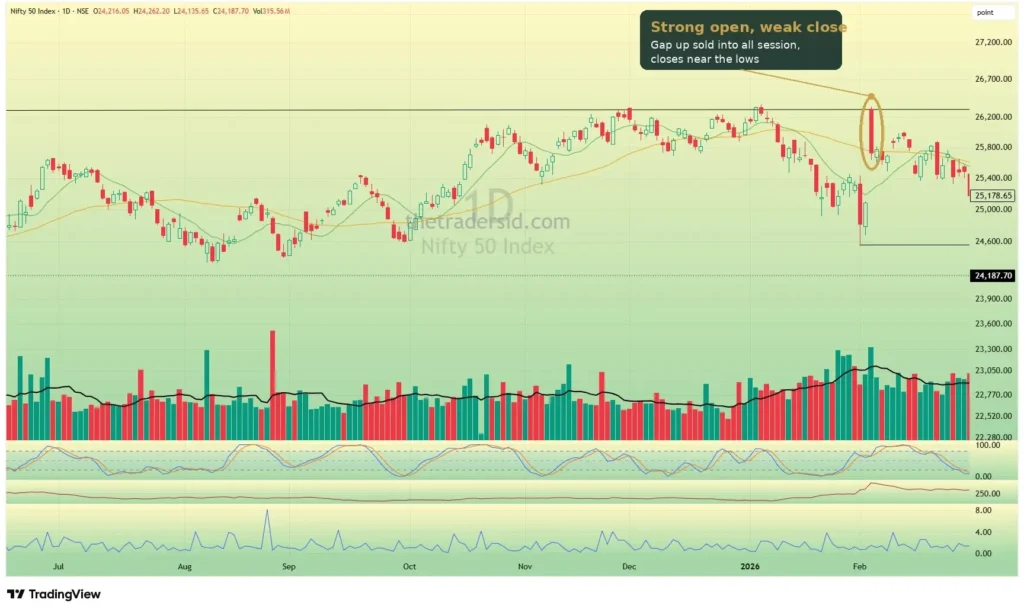
I trade off the weekly chart. Every setup I take, Triangle, HTF, or Gap Up, is built and confirmed on weekly candles. But the days that make up each week aren’t noise. How Nifty opens and closes each day, especially the shape of that open to close move, tells you something about who’s actually in control before the week even finishes printing. I don’t trade off this intraday. I read it.
The Two Patterns That Matter
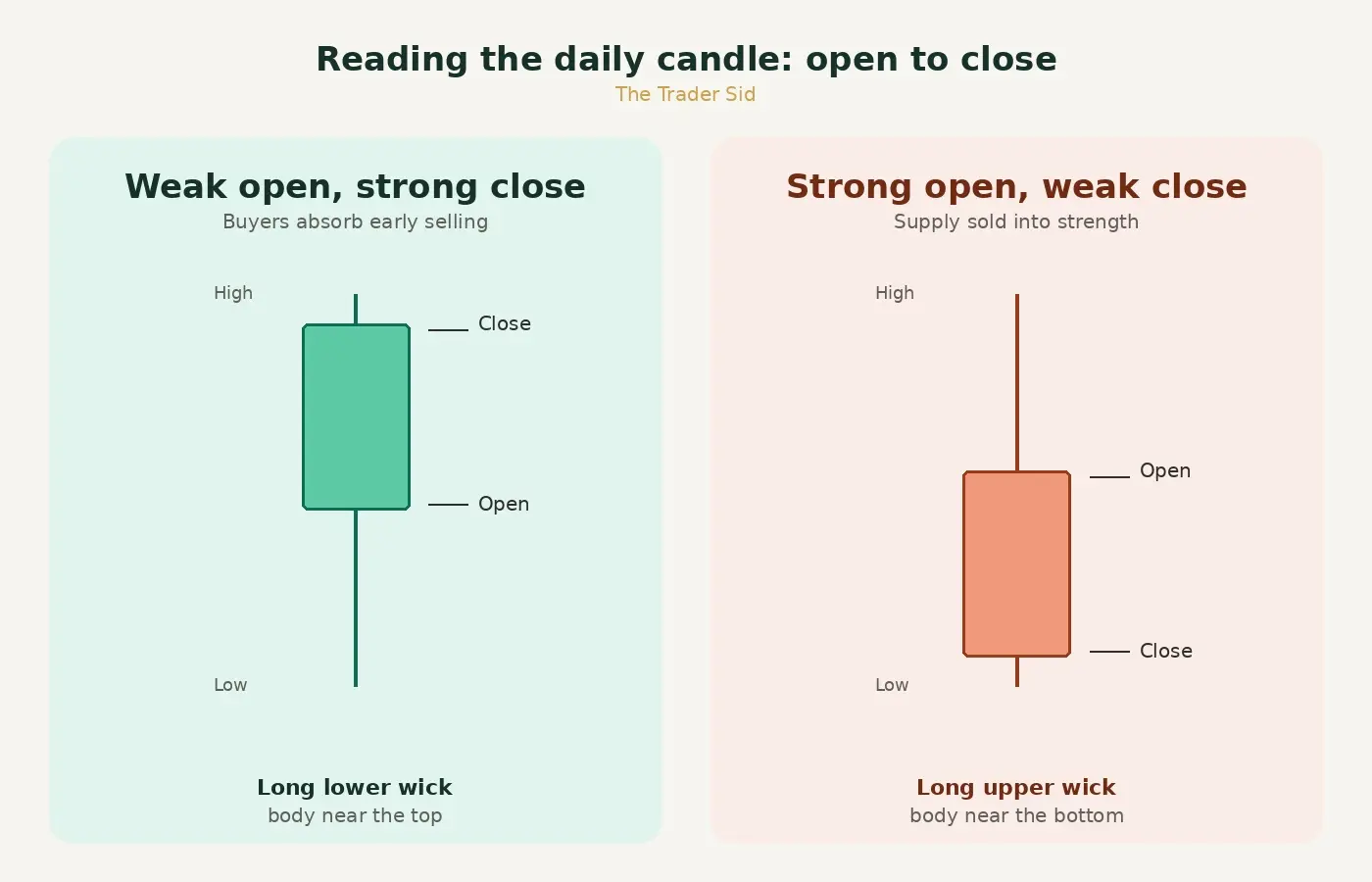
There are two shapes worth paying attention to.
Weak open, strong close. The index opens soft, maybe even gaps down, and then spends the session climbing, closing near the highs of the day. This is buyers stepping in to absorb whatever selling showed up early. It’s a sign of demand, and when it repeats across several sessions, it tends to build into a genuinely strong week.
Strong open, weak close. The index gaps up or opens firm, then fades all session, closing near the lows. On the surface this looks bullish, you saw green in the morning. But a strong open that can’t hold into the close is often supply being sold into strength rather than demand taking control.
The close matters more than the open. The open reflects overnight sentiment and headline reaction. The close reflects what happened after everyone had all day to act on that sentiment. When the two disagree, trust the close.
Why Strong Opens Fail In A Weak Tape
This is the part that trips up most traders. After a stretch of red days, when futures finally turn green and stocks are up premarket, the instinct is to read it as the market saying it’s done falling. It feels like relief. It feels like validation.
That reading is often exactly backwards, and it’s precisely why this setup works so well for distribution. A weak tape doesn’t repair itself in one green premarket session. What a gap-up in a weak market actually creates is opportunity, just not for the side that’s excited about it.
Trapped longs get their exit. Traders who held through the prior selloff, hoping for a bounce to get out even, finally get a price where they can sell without taking the full loss. They take it.
Short sellers get their entry. Traders who recognize the broader tape is still in a sell cycle see the gap-up as free supply. Rather than fighting the strength, they sell into it, initiating or adding to short positions, expecting the sell cycle to continue.
Both groups are selling into the same gap-up, for different reasons, at the same time. That’s not a market saying it no longer cares about what caused the selloff. That’s the market handing sellers a better price to keep selling at.
The Trap For Traders Holding Positions
If you’re holding something you probably should have already sold, a strong open reads as validation. The stock is green, the pain stops, the decision to exit gets postponed another day. This is exactly the psychology distribution days are built to exploit. The bounce doesn’t need to be real or lasting. It just needs to be convincing enough, for long enough, to give the people who need to sell somewhere to sell into.
The other trap is chasing. Seeing green after red and jumping in on the assumption that the worst is over is rarely a high probability trade in a market that’s still structurally weak. You’re buying into the same gap-up that trapped longs and short sellers are both using as their exit and entry respectively. You’re on the wrong side of both trades at once.
What I Actually Do With This
I don’t act on a single day’s open to close shape in isolation. What I watch for is the pattern repeating, and how it lines up with the weekly picture I’m already building.
If Nifty has had a rough stretch and then gaps up, I don’t treat the gap as a green light. I let the session play out. If it closes weak, that’s supply getting sold into the strength, exactly as described above, and it reinforces that the weak conditions are still in force. That tells me to stay cautious with new positions and sizing, consistent with how I already treat a choppy or fading weekly picture.
If instead the market gaps down after a stretch of selling and then grinds higher into a strong close, and does that more than once, that’s a genuinely different signal. That’s demand actually absorbing supply rather than supply parading as strength. It’s one of the things that can mark the early stages of a range low holding and a real low forming, which is what I eventually want to see confirmed on the weekly chart before getting aggressive again.
Either way, the rule is the same. Let the morning shake out. Don’t react to the open. Let supply get absorbed or exposed by the close, and only then ask whether buyers actually reclaimed control for the day. That daily answer, repeated and stacked across a week, is what eventually shows up as a real weekly candle worth acting on.
The Discipline Part
None of this changes my entries, stops, or position sizing rules. It changes patience. A strong premarket or a green open by itself has never been a reason to buy, and a stock bouncing off a selloff has never been a reason to keep holding something that already broke your thesis. The close is the only part of the day that reflects what actually happened after everyone had a full session to act. Everything before that is just noise dressed up as a signal.