This is the fourteenth post in my Real Trade Series, where I go through actual trades from my own charts and journal notes, wins, losses, and everything in between. After writing about two trades where I sold out of panic rather than process, I wanted to include this one specifically because it’s the opposite case, an exit that looked similar on the surface but was actually backed by real reasoning.
RITES is a smaller win in terms of percentage gain compared to some of the other trades in this series, but I think it’s one of the more important posts to include, because it shows what a properly reasoned exit actually looks like, right after two trades where my exits weren’t.
The setup
RITES had a strong move through the middle of 2023, climbing steadily from around 300 early in the year up through 500 by late August. By the end of August, price had pushed into a tightening consolidation just under its recent highs, a pattern that often either continues higher or rolls over depending on how the stock behaves inside that range.
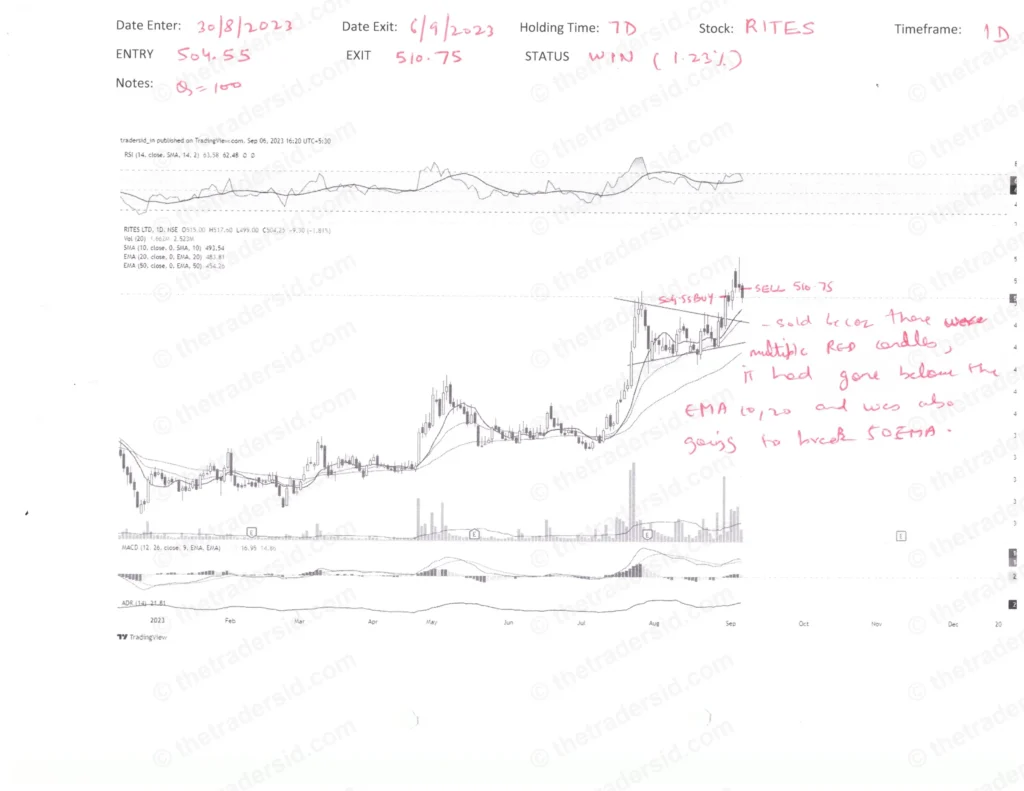
I entered on 30th August at 504.55, with a quantity of 100 shares.
How the trade played out
Seven days later, on 6th September, I exited at 510.75, a gain of 1.23 percent. That’s a modest result, smaller than several of the other wins in this series, but the size of the gain isn’t really what makes this trade worth writing about.
What matters here is why I exited when I did, and my notes are specific about it in a way that’s different from the last two posts. I wrote that I sold because there were multiple red candles, price had gone below the 10 and 20 EMA, and it was also going to break the 50 EMA.
Why this exit was different
Compare this reasoning to what happened in the JSW Energy and Ashapura Minechem trades. In both of those, my notes describe panic selling, an emotional reaction to price moving against me without a specific technical trigger behind the decision. Here, the notes describe an actual sequence of technical developments, consecutive red candles, a break below two moving averages I track closely, and a clear risk of breaking a third.
This is exactly the kind of structured reasoning I want behind an exit decision. It’s not perfect, and it’s certainly not guaranteed to be right every time, but it’s a real process rather than a reaction to discomfort. The multiple red candles gave me a pattern to observe rather than a single scary looking candle to react to. The break below the 10 and 20 EMA gave me a concrete technical level that had actually been violated, not just a feeling that the trade was going wrong. And the approach toward the 50 EMA gave me a forward looking reason to act before an even more significant level was potentially broken too.
Why a smaller gain here is actually fine
I think there’s a temptation to look at this trade’s 1.23 percent return next to the 5 or 6 percent gains in some of the other posts in this series and see it as a lesser result. I don’t think that’s the right way to read it. A trade that exits on legitimate technical deterioration, even for a smaller gain, is a healthier outcome than a trade that exits on panic and happens to produce a bigger number because the underlying trend bailed out an emotional decision.
If I only measured trades by the size of the gain, I’d be tempted to conclude that the panic exits in JSW Energy and Ashapura Minechem were actually fine, since one of them still made money. But measuring by process rather than just outcome, this smaller win is actually the better executed trade of the three, because the reasoning behind the exit would hold up regardless of what price did immediately afterward.
What I take from this trade
The real value of this post, sitting right after two trades about panic selling, is having a clear contrast to point back to. When I’m asking myself in the future whether an exit decision is legitimate or emotional, this is the kind of standard I want to hold myself to. Specific, observable conditions, multiple red candles, a break of defined moving averages, a real risk of breaking a further significant level, rather than a general sense of discomfort about where price is trading relative to my entry.
Building this into an actual process
Looking at this trade next to the two panic selling posts, I think there’s a genuinely useful checklist forming here, one I want to actually use rather than just notice in hindsight. Before exiting a position early, I want to be able to point to something concrete, similar to what happened in this RITES trade. A specific number of red candles, a defined moving average that’s actually been broken, a level that’s genuinely at risk of breaking next. If I can’t point to something like that and I’m just reacting to how the position feels in the moment, that’s exactly the signal to pause rather than act, based on what happened in the other two trades in this series.
This trade is a smaller win in terms of the number, but I think it’s actually one of the more useful entries in this journal, precisely because it shows the difference between an exit I can defend with real reasoning and an exit I can only explain afterward as panic.