This is the nineteenth post in my Real Trade Series, where I go through actual trades from my own charts and journal notes, wins, losses, and everything in between. This one is short, because the trade itself was short. It’s also one of the more uncomfortable ones to write up, because there isn’t a clever lesson buried in a good process that just didn’t work out. The process wasn’t there at all.
A general note that applies to this post and several others in this series: the open and close dates and times shown come from when the trade was recorded in my trade journal, not necessarily the exact timing the order was actually placed and filled in the market. There can be a gap between the two, and readers should discount the precise timestamps accordingly rather than treating them as a live, tick-by-tick record of execution.
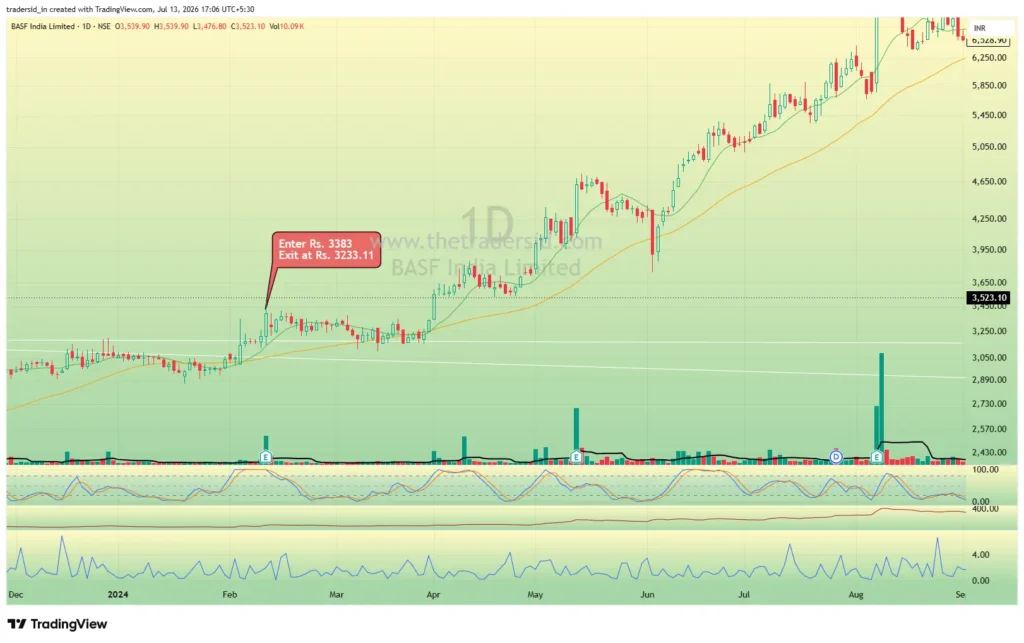
A quick note on the chart below: I didn’t save a screenshot from the actual day of this trade. The entry, exit, and stop levels here are pulled straight from my trade journal, but the chart markup is done on today’s chart, placed at the historical dates and prices from that journal entry, not a live screenshot from February 2024. Wanted to flag that upfront rather than let it pass as something it isn’t.

What I was looking at
BASF popped up on an alert on 12th February 2024. I don’t fully remember what triggered it anymore, and that’s part of the problem with this trade. There was no setup I’d been tracking for days, no base I’d marked up on the weekly chart, no plan sitting in my notes waiting for a breakout. The alert fired, I looked at the chart, and I bought.
What I actually did
I entered at 3,383. Within the same session, I was out at 3,233.11. That’s a loss of close to 7,500 rupees, and the entire trade, entry to exit, happened inside a single day.
Why this one fell apart
Looking back at my own notes from that day, I wrote it out plainly: there was no proper entry strategy. I entered immediately, right on the alert, without checking what was actually driving the move. It turned out BASF had an earnings release that day, and the candle I was reacting to had expanded because of that release, not because of a breakout I’d identified through my own process.
I also exited out of nervousness. Not because a stop got hit, not because the setup invalidated. I got uncomfortable holding the position and closed it.
For what it’s worth, the broader trend wasn’t the problem here. Looking back at the chart, BASF was in a genuine, sustained uptrend at the time, well above both moving averages, with the shorter average riding above the longer one the way it should in a healthy trend. That actually makes this trade harder to excuse, not easier. The setup being caught inside a strong uptrend wasn’t what went wrong. What went wrong was that there was no setup at all, just a reaction to a single expanding candle on earnings day.
What was actually missing
Every other trade I write about in this series, win or loss, usually has some version of a real decision behind it. A base I’d been watching. A stop I’d calculated. A reason I can point to, even when that reason turned out to be wrong. This one didn’t have that. I skipped the process and reacted to a price move instead of a setup, and I paid for it twice: once by entering blind, and once by exiting on emotion instead of a plan.
Earnings day price action is also just a different animal from the weekly breakout setups I actually trade. A stock can expand hard on a single candle because of a number in a press release, not because supply and demand have been building for weeks the way they do in a genuine base. Reacting to that kind of move as if it were a technical breakout was the core mistake here, not the trend the stock happened to be in.
What this trade taught me
The money lost on this one is small compared to some of the other trades in this series. The real cost was letting an alert substitute for a setup. If I don’t have a level I’ve marked up in advance, a reason I can write down before I click buy, and a stop that comes from that reason rather than from how I’m feeling once I’m in the trade, I’m not actually trading my system. I’m just reacting. And the fact that the trend itself was actually fine makes that clearer, not murkier. Even a stock in a healthy uptrend isn’t a trade if there’s no real reason behind the entry.
This is exactly the kind of trade I don’t want to hide. It’s not a loss inside a good process. It’s a reminder of what happens when the process doesn’t happen at all.