This is the seventeenth post in my Real Trade Series, where I go through actual trades from my own charts and journal notes, wins, losses, and everything in between. This one is a small, same day loss, but the reasoning behind the exit is different from anything else I’ve written about so far in this series, and I think it’s worth including for that reason alone.
Parag Milk Foods gave me a quick, small loss, but what makes this trade worth writing about isn’t the outcome. It’s the specific reason I gave myself for exiting, which relies on reading the strength of buying and selling activity rather than a clean technical level being broken.
The setup
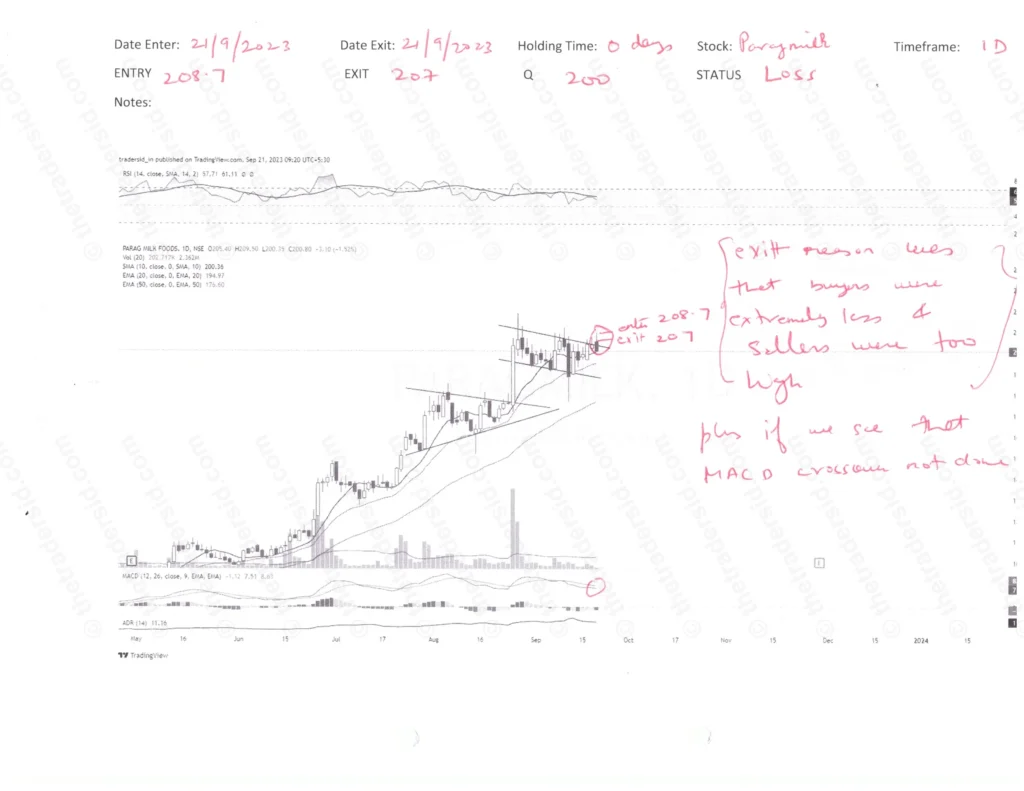
Parag Milk Foods had a strong run through the middle of 2023, climbing from around 100 in May up past 200 by September, with a tightening consolidation forming just under recent highs heading into this trade. I entered on 21st September at 208.7, with a quantity of 200 shares.
The same day exit
This trade didn’t last. I exited the same day at 207, a small loss. My notes on this one are more about market behavior than price levels, and I think it’s worth walking through them closely because they represent a different kind of reasoning than most of the other trades in this series.
I wrote that my exit reason was that buyers were extremely less and sellers were too high. In plain terms, I was reading the balance of buying and selling pressure in the moment, not waiting for a specific candle to close below a specific level. On top of that, I noted that the MACD crossover had not been completed yet, meaning the momentum indicator I use hadn’t actually confirmed weakness at the point I made this decision. I was acting ahead of that confirmation, based on what I was seeing in the order flow and price behavior directly.
Why this is a different kind of exit than the others in this series
Compare this to the RITES trade, where I waited for multiple red candles and an actual break below the 10 and 20 EMA before exiting. Or the Coal India trade, where I exited too early based on a visual sense that the stock looked overextended relative to its moving averages. This trade sits somewhere between those two in terms of process, but the specific tool I was using was different from both.
Reading buyer and seller strength directly, rather than waiting for a lagging indicator like a moving average or MACD to confirm it, is a genuinely different skill from pattern recognition on a chart. It’s closer to reading the immediate supply and demand in the stock than it is to reading structure. This can be a faster way to catch weakness before it shows up on the chart, but it’s also more subjective and harder to verify after the fact than a clean break of a specific level.
Was this the right call, even though it lost
I think this is a genuinely interesting question to sit with, separate from whether the trade made or lost money. The MACD crossover hadn’t happened yet when I exited, which means by the time the chart itself would have given me a standard signal to get out, I’d already acted. If my read on buyer and seller strength was accurate, this could actually represent getting out ahead of a larger move down, even though the specific number on this particular trade was a small loss rather than a big save.
I don’t have a clean way to prove that from this one trade alone. A small loss on an early, feel based exit could just as easily mean I got out of a trade that would have continued working, the same mistake pattern as Coal India, just using a different justification this time. The difference between reading real weakness early and reading normal noise as weakness is genuinely hard to tell apart in the moment, and I think that’s the honest takeaway here rather than a clean lesson in either direction.
What I take from this trade
I want to treat this trade as a genuine open question rather than force it into either the panic selling category from earlier in this series or the well reasoned exit category like RITES. It sits in between. The reasoning was real and specific, buyers being weak and sellers being aggressive, but it wasn’t backed by a confirmed technical signal like a completed MACD crossover or a broken moving average.
Going forward, I think the useful distinction to build into my process is separating exits based on order flow reads from exits based on confirmed technical signals, and being honest with myself about which one I’m actually using in the moment. Both can be valid, but they carry different levels of reliability, and mixing them up, treating a feel based read with the same confidence as a confirmed signal, is probably where trades like this one either work out well ahead of the chart or turn into another version of the Coal India mistake, jumping the gun on something that hadn’t actually happened yet.
Where this leaves the broader exit discipline theme
Looking at this alongside RITES, Coal India, JSW Energy, and Ashapura Minechem, I think I now have a genuinely useful range of examples covering different exit triggers, panic with no real reasoning, a visual read that jumped ahead of confirmation, a fully confirmed technical break, and now an order flow based read that also got ahead of confirmation but for a more specific reason. Comparing these side by side is more useful to me than any single trade in isolation, because it’s starting to show me where my instincts are actually reliable and where they tend to get ahead of what the chart has actually confirmed.