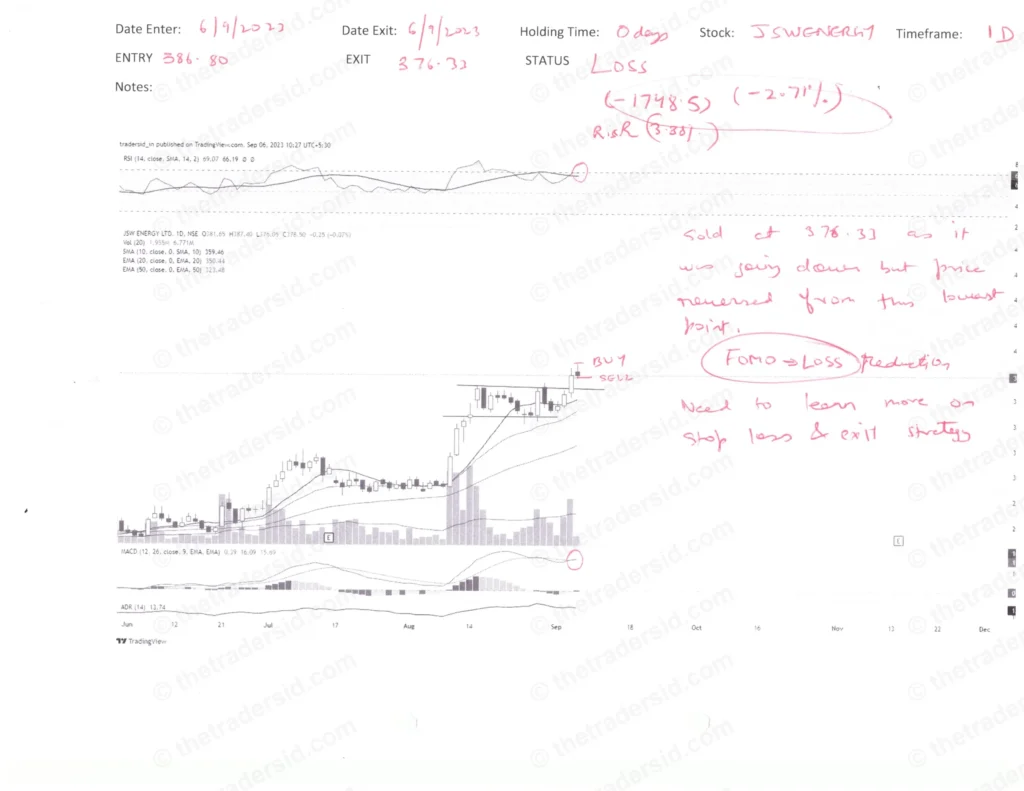
This is the eleventh post in my Real Trade Series, where I go through actual trades from my own charts and journal notes, wins, losses, and everything in between. This one is a same day trade, and the mistake is one that’s easy to describe but genuinely hard to avoid in the moment.
Some trades fail because of a bad entry. This one failed because of how I handled the exit, on the very same day I got in, and my own notes are unusually direct about what actually happened.
The setup
JSW Energy had been building strength through the middle of 2023, with a clear base forming through July and into August before the stock broke out into a strong move higher. By early September, price had pushed up out of a tight range and was continuing to climb, exactly the kind of breakout continuation I look for.
I entered on 6th September at 386.80.
What happened the same day
This trade didn’t last. I exited the same day, at 376.32, a loss of about 2.71 percent, or roughly 1748.5 in absolute terms on my position, against an intended risk of 3.80. My notes describe exactly what happened in the moment, and I want to keep this close to how I actually wrote it. I sold at 376.32 because price was going down, but price reversed from that exact lowest point right after I sold.
In other words, I panicked out near the low of the move, and the stock turned around almost immediately after.
Why this is such a common mistake
I labeled this one directly in my notes, FOMO leading to loss, and I think that’s worth unpacking, because this isn’t the usual FOMO story from earlier in this series. Most of the FOMO entries I’ve written about involve chasing a stock into a position. This is FOMO working in reverse, watching a position move against me and feeling pressure to get out before the loss got worse, even though the actual planned risk on the trade hadn’t been hit yet.
My own numbers make this clear. My intended risk was 3.80. The loss I actually took was larger than that, which tells me I didn’t hold to my own stop loss level. I sold on the emotional discomfort of watching price fall, not because price had actually reached the point where my plan said to exit.
The reversal
The part of this trade that stings a little more than a normal loss is that price reversed almost exactly where I sold. This happens more often than people like to admit. A stock dips, feels like it’s falling apart, and a lot of traders exit right around that low point simply because that’s when the discomfort of watching the position peaks. The stock doesn’t know or care where your exit order sits. It was simply testing a level, shaking out exactly the kind of nervous selling that I ended up contributing to, before continuing higher.
I don’t think there’s a clean technical lesson buried in the exact price level here. The lesson is entirely about behavior. I exited based on how the drop felt to watch, not based on where my plan told me to exit.
What I take from this trade
I wrote something at the end of this journal entry that I think is more valuable than any specific technical note, and I want to leave it mostly as I wrote it. Need to learn more on stop loss and exit strategy.
That’s a broader admission than most of the notes in this series, and I think it’s an honest one. This wasn’t a trade where I can point to a specific missed confirmation or an unconfirmed close the way I could with some of the earlier posts. This was a trade where my actual exit process wasn’t well defined enough to survive a moment of real pressure. I had a risk number in mind, 3.80, but I didn’t have a clear enough rule for what I’d actually do if price dropped toward that level, and in the absence of a clear rule, I made an emotional decision instead.
What I’d do differently
The fix here isn’t a new pattern or a smarter entry. It’s building an actual exit framework that holds up under pressure, something more specific than a rough risk number I’m mentally tracking. A defined stop loss level, placed before the trade, that I commit to holding unless price actually reaches it, would have kept me in this trade through the exact dip that shook me out.
This trade is a reminder that having a plan and having a plan that survives contact with a falling position are two different things. I clearly had some sense of my risk going in, 3.80, but that number wasn’t backed by a concrete stop order or a firm enough commitment to hold it. The next version of my process needs to close that gap, not just for this stock, but for every trade where price moves against me before it’s actually invalidated the setup.