This is the thirteenth post in my Real Trade Series, where I go through actual trades from my own charts and journal notes, wins, losses, and everything in between. This one’s a win, but the notes I left myself are really about a habit I’m still trying to break, panic selling, even on trades that are actually working.
Ashapura Minechem is a good trade to pair mentally with the JSW Energy post earlier in this series. Both trades involve me exiting because a price move made me uncomfortable, not because my actual plan called for an exit. The difference is that JSW Energy turned that instinct into a loss. This one turned it into a smaller win than it should have been.
The setup
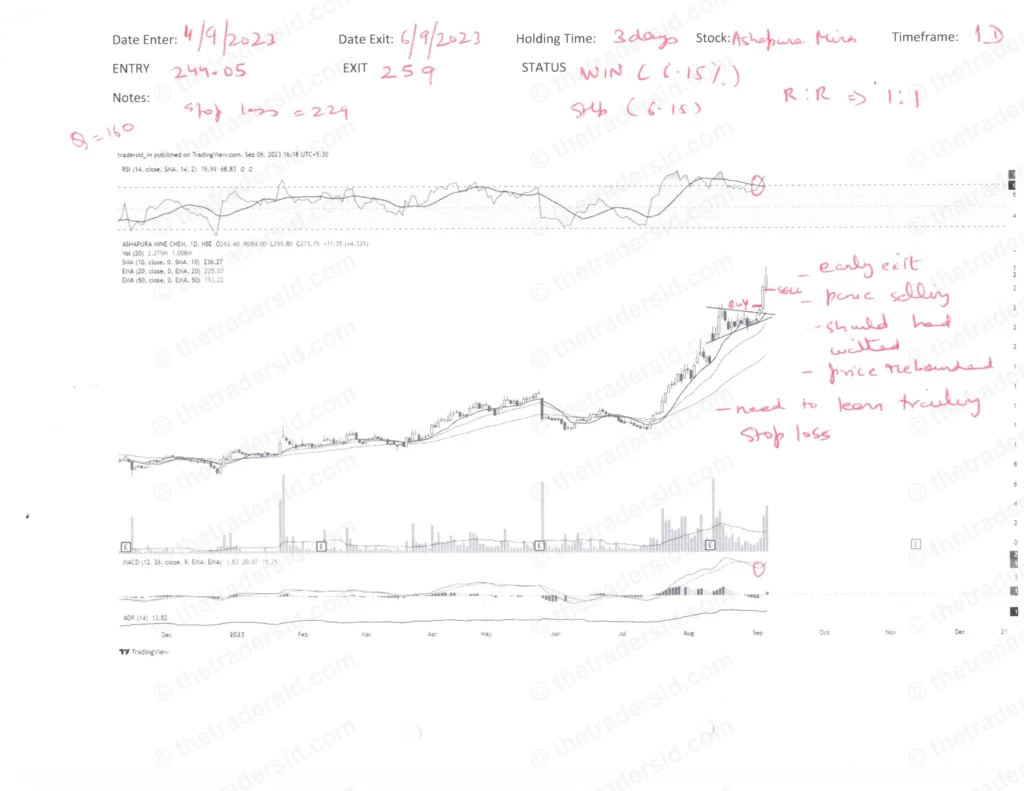
Ashapura Minechem had a long, steady climb through 2023, building slowly from the back half of the previous year and accelerating through the middle of the year. By early September, the stock had pushed into a tightening pattern near its highs, and I entered on 4th September at 244.05, with a quantity of 160 shares and a stop loss set at 229.
That stop loss placement gives a real risk to reward number to work with here, and it’s worth stating plainly. My risk to reward on this trade came out to 1 to 1.
How the trade actually went
Two days later, on 6th September, I exited at 259, a gain of 6.15 percent. Status: win. On paper this looks straightforward, a solid short term gain on a trending stock.
My own notes tell a more complicated story about how that exit actually happened. I wrote early exit, and right underneath it, panic selling. Then, a note that’s more honest than most trading journals bother to be: should have waited. And finally, price rebounded.
What actually happened at the exit
Reading through these notes together, the picture is fairly clear. I sold into strength or into a small dip, I’m not entirely sure which from the notes alone, but the key point is that I sold out of discomfort rather than because price had actually hit my stop or reached a planned target. And then, just as the note says, price kept moving in my favor after I’d already sold.
This is the same behavioral pattern from the JSW Energy trade, showing up again, just with a better outcome this time because the underlying trend was strong enough to still produce a gain even with an early exit. The process mistake is the same. The market simply treated me more kindly on this occasion.
Why a win doesn’t cancel out the mistake
I think it would be easy to look at a 6.15 percent gain and consider this trade a success without much more thought. But my own notes specifically call out that this was panic selling, and that I should have waited. If I only pay attention to trades that lost money, I’m going to miss exactly this kind of pattern, a real behavioral issue that happened to produce a good result anyway.
The risk to reward number here matters too. A 1 to 1 ratio is right at the edge of what’s usually worth taking, well below the 1 to 2 minimum I use as a general standard. Combined with an early, panicked exit, this trade actually captured less of the available reward than the setup itself was designed to offer, on a risk to reward profile that was already fairly tight to begin with.
The pattern connecting this to JSW Energy
Looking at this trade alongside the JSW Energy loss from earlier in this series, I think there’s a clear behavioral thread running through both of them. In JSW Energy, panic selling turned a position that hadn’t hit my stop into a realized loss, right before price reversed. Here, panic selling turned a position that was working into a smaller gain than it should have been, again right before price continued in my favor.
Both trades have price reversing shortly after I sold, in the direction I would have wanted if I’d simply held. That’s not a coincidence I think I can keep attributing to bad luck. It’s a sign that my actual exit behavior under pressure, whether the position is red or green, tends to trigger right around normal volatility rather than at any real technical level.
What I take from this trade
I wrote it plainly at the bottom of this journal entry, and I think it’s the right way to close this one out. Need to learn trailing stop loss. This is the second trade in a row in this series, after Birla Cable, where the actual lesson isn’t about the entry or the setup, it’s about needing a more mechanical, less emotional way to manage an open position once it’s already working in my favor.
A trailing stop loss, tied to something concrete like a previous day’s low or a moving average, would remove the moment by moment decision making that’s currently leading me to exit on instinct rather than on an actual signal. Both this trade and JSW Energy would likely have played out better with that kind of structure in place, not because the entries were wrong, but because the part of my process governing what happens after entry isn’t well defined enough yet.
What I’d do differently
The specific change I want to make, and I’m now seeing this same need show up across multiple trades in this series, is building a trailing stop rule I actually use rather than relying on my read of price action in the moment. Something anchored to structure, like the low of the prior day or a specific moving average, that only exits the trade when that level is actually broken, not whenever the position dips enough to make me uncomfortable.
This trade worked out fine in the end. But fine isn’t the same as well managed, and I’d rather fix this pattern now, while it’s only costing me some upside, than let it keep showing up on trades where the cost is a full loss instead.