This is the eighteenth post in my Real Trade Series, where I go through actual trades from my own charts and journal notes, wins, losses, and everything in between. This one is a small loss, but the story behind it is really about a profit I had and didn’t take, not about a bad entry.
Titan is a useful trade to add to the exit discipline theme running through this series, because it shows a version of hesitation I haven’t written about yet. This isn’t panic selling into a drop. It’s the opposite, freezing while a trade is working, and watching that opportunity slip away.
The setup
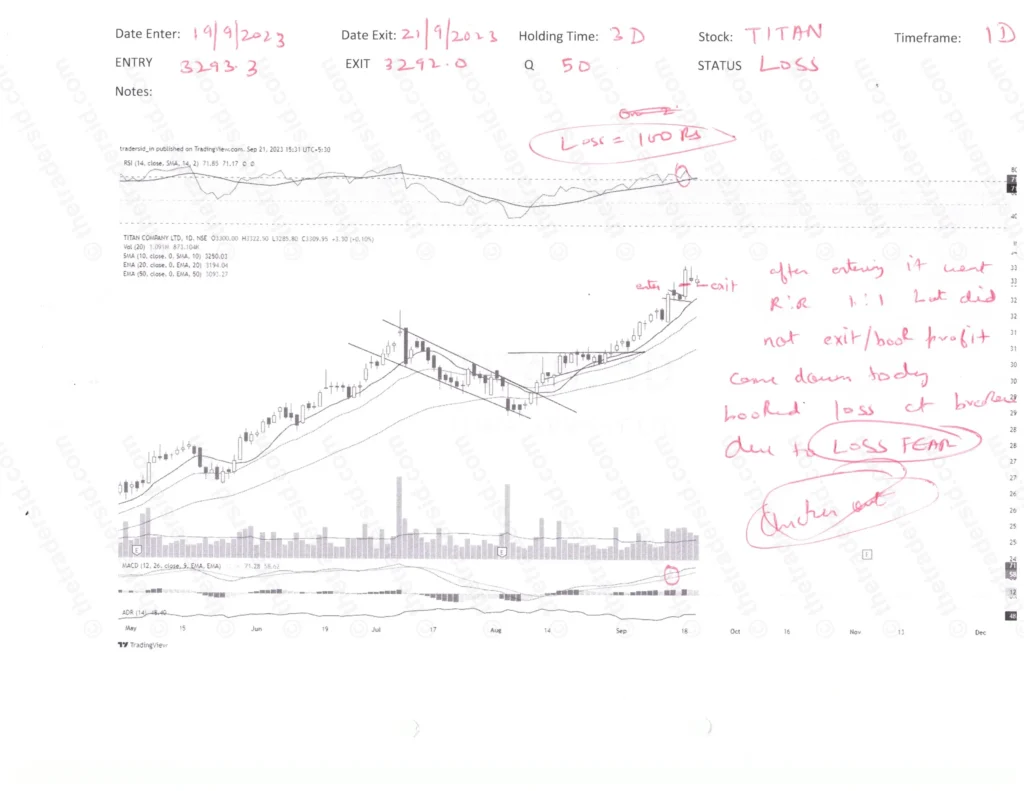
Titan had a strong, extended uptrend through most of 2023, with a clean pullback and recovery pattern visible on the daily chart through the middle of the year before pushing to new highs by September. I entered on 19th September at 3293.3, with a quantity of 50 shares.
What happened after entry
My own note describes exactly what unfolded, and I want to keep it close to how I wrote it. After entering, it went in my favor, and the risk to reward reached 1 to 1. At that point, I had a real, in hand profit, matching my initial risk. I didn’t exit or book any of it.
Instead, the note continues, the stock came back down the same day. I looked at the loss at that point and, in my own words, chickened out due to loss fear.
Two days later, on 21st September, I exited at 3292.0, a small loss of about 100 rupees. Status: loss.
Why this is a different mistake than the others in this series
Every other exit related post in this series so far has been about getting out too early, whether from panic, from an overly cautious read of an extended stock, or from an order flow judgment that got ahead of confirmation. This trade is the opposite problem. I had a real profit, matching my risk one to one, and I didn’t act on it in either direction. I didn’t take the profit, and I didn’t hold with a plan for what would happen if it reversed. I just watched.
By the time price actually did come back down, I wasn’t making a fresh decision anymore. I was reacting to a loss that had already happened, from a position that had already been in profit shortly before. My own note names the feeling behind this directly, loss fear, and separately, chickening out, which I think is worth sitting with honestly rather than softening.
The specific moment that mattered
The critical point in this trade wasn’t the entry, and it wasn’t really the final exit either. It was the moment the risk to reward hit 1 to 1 and I had a real choice to make, take some profit, tighten a stop to protect what I had, or consciously decide to hold for more with a defined plan for what happens if it turns. I didn’t do any of those things. I just held without a plan, which meant that when the stock did reverse, I was making my actual decision under the worst possible conditions, already watching a gain disappear, with fear rather than a plan driving the outcome.
Why freezing is its own category of mistake
I think it’s worth naming this as distinct from both the panic selling trades and the premature exit trades earlier in this series. Panic selling exits too early because red candles feel uncomfortable. Premature exits like Coal India get ahead of actual confirmation because a stock looks extended. This trade didn’t exit too early or too late in a clean sense. It just didn’t have an active decision made at the one point where a decision was actually available and useful, when the trade had already reached a reasonable profit.
Freezing at that moment meant the choice got made for me, by the market, once price reversed and fear took over. That’s a fundamentally passive way to end up on the losing side of a trade that had, at one point, already proven itself right.
What I take from this trade
The lesson here connects directly to the trailing stop loss theme that’s come up repeatedly in this series, in Birla Cable, JSW Energy, and Ashapura Minechem. If I’d had an actual trailing stop rule in place once this trade hit 1 to 1, either locking in a partial profit or tightening the stop to protect the gain, the outcome here would have been decided by that rule, not by how I felt watching the stock come back down two days later.
This is maybe the clearest example in the whole series of why I keep writing that same note, need to learn trailing stop loss, across so many of these journal entries. It’s not just about avoiding panic exits on the way down. It’s about having a defined plan for what happens once a trade moves in my favor, so that a real profit doesn’t quietly turn into a loss simply because I didn’t have a rule telling me what to do at the moment it mattered most.