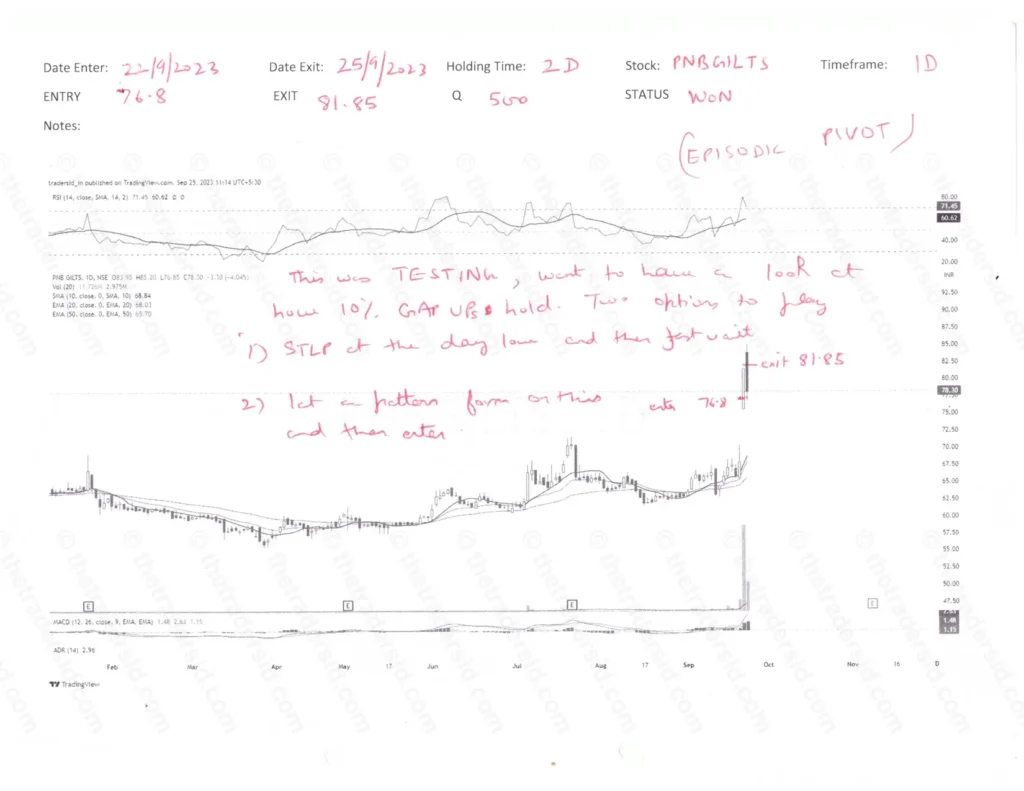
This is the second post in my Real Trade Series, where I go through actual trades from my own charts and journal notes, wins, losses, and everything in between. This one comes straight from a handwritten trade sheet, gap ups, stop placement, and the kind of quick decision making that happens when a stock moves fast and you don’t have days to sit and wait.
Most of the setups I talk about are slow builds. A stock forms a base over several weeks, volatility contracts, volume dries up, and eventually it breaks out on strength. PNB Gilts was not that kind of trade. This one was about something completely different, a sharp gap up move, and figuring out in real time how to actually trade it.
What I was looking at
PNB Gilts had spent most of the year grinding sideways to slightly higher, nothing dramatic, just a slow climb with the usual ups and downs you’d expect from a stock without a strong trend yet. Then in late September 2023, it gapped up hard. We’re talking a double digit percentage move in a single session, the kind of gap that immediately gets your attention because it usually means something changed, earnings, news, some kind of catalyst that shifted how the market was pricing the stock.
I wrote this down on my journal sheet at the time as testing, and that word matters here. I wasn’t trading this with full conviction the way I would a clean VCP breakout on the weekly chart. I was specifically trying to learn something, how do these ten percent plus gap up moves actually behave once they happen. Do they hold. Do they fade back. Is there a way to actually trade the continuation without getting shaken out on the first pullback.
The two ways to play a gap like this
Before entering, I wrote out two possible approaches, because there isn’t just one right way to handle a big gap up.
The first approach is to enter close to the gap itself, place your stop loss at the low of the gap day, and then just wait. This is the more aggressive route. You’re betting that the gap represents real new information the market is digesting, and that the stock is unlikely to give back the entire move and fall below where the gap day started. Your risk is defined by that day’s low, and beyond that, you’re not trying to time anything cleverly, you’re just letting the trade play out.
The second approach is more patient. Instead of entering right into the gap, you wait for some kind of pattern to actually form on top of it, a few days or weeks of consolidation, maybe a small flag or tight range, and then you enter once that structure gives you a cleaner, lower risk entry point. This approach usually means you enter later and potentially at a higher price, but your stop loss can be tighter and your setup is more defined.
Both of these are legitimate ways to trade an episodic pivot like this. Neither one is wrong. They just carry different risk profiles and suit different situations.
What I actually did
For this trade, I went with the first approach. I entered at 76.8, with my stop placed at the low of the gap day. My reasoning was straightforward, the move looked strong enough, and the volume behind it was significant enough, that I wanted exposure to it without waiting for a pattern that might never form cleanly, or might form after the bulk of the move had already happened.
Two days later, on 25th September, I exited at 81.85. That’s roughly a six and a half percent gain in two trading days, on a stock I held for a very short window compared to my usual swing positions.
Why I didn’t wait for a pattern to form
This is really the core decision in this trade. If I had gone with the second approach, waiting for a pattern to form on top of the gap, I might have ended up with a tighter, cleaner entry. But I also might have missed the move entirely if the stock simply continued higher without ever giving me a clean pattern to enter on. Gap up stocks that are being driven by strong underlying demand don’t always pause to build you a nice base. Sometimes they just keep going.
I made a judgment call that the risk of missing the move outweighed the benefit of a cleaner entry, given how the gap looked and how the volume confirmed it. That judgment call worked out this time. That doesn’t mean it will always be the right call, which is exactly why I still wrote down the second approach as something worth testing on a future trade like this.
What I’m still learning about this kind of setup
I want to be honest about something here. This trade worked, but two days and one trade isn’t enough to say the first approach is definitively better than the second. That’s part of why I labeled the trade as testing in my notes. I was genuinely trying to build a feel for how these situations behave, not just executing a fully proven strategy.
This is different from how I’d talk about a standard VCP or HTF breakout, where I’ve backtested the pattern extensively and have a much clearer sense of expected outcomes. Episodic pivots are trickier. They’re driven by sudden information, not slow accumulation, and that means the historical base of trades I can draw on for this specific pattern is smaller. I’m still building conviction around exactly when approach one makes sense versus when approach two is the safer route.
What this trade taught me
The biggest thing I took from this one isn’t really about PNB Gilts specifically. It’s about having a defined plan for a type of setup before you’re in the middle of it. Gap ups happen fast. You don’t get days to sit and think about your entry the way you do with a slow base building on the weekly chart. Having already worked out two possible approaches, and understanding the tradeoff between them, meant I wasn’t improvising when the moment came. I was choosing between two plans I’d already thought through.
That’s a different skill from spotting a good chart pattern. It’s about having pre built decision frameworks ready for the situations that move too fast for you to think clearly in the moment. I think that matters just as much as the technical setup itself, maybe more, because the technical setup only tells you what to look for. It doesn’t tell you what to actually do once you’re staring at a ten percent gap up and a clock that’s already running.
If you keep a trade journal, even something as simple as this handwritten sheet, I’d encourage you to write down the alternative approach you didn’t take, the same way I did here. It’s easy to only record what you did. Recording what you chose not to do, and why, is often where the real learning happens.