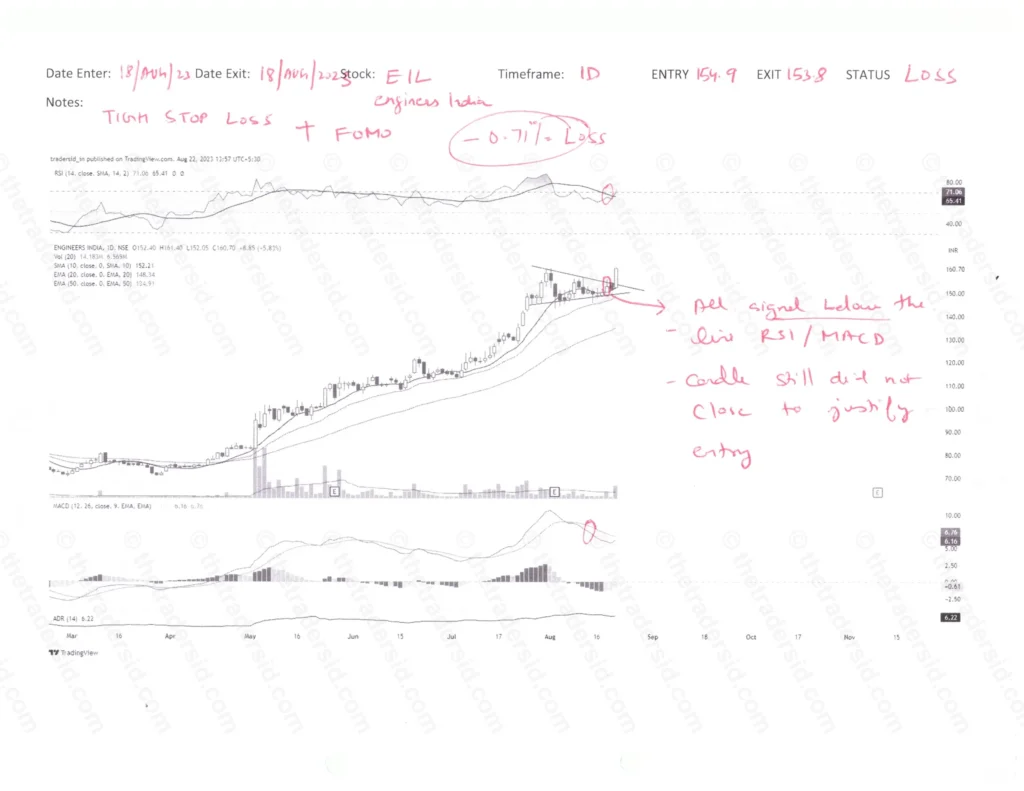
This is the fifth post in my Real Trade Series, where I go through actual trades from my own charts and journal notes, wins, losses, and everything in between. This one is a loss, and it’s a useful one to publish right after the Mazagon Dock trade, because it’s almost the same mistake showing up again, just two days apart.
Sometimes the most valuable thing a trade journal does isn’t teach you something new. It’s show you that you’re repeating something you already knew. This trade in Engineers India is exactly that kind of entry.
Where the stock was coming from
Engineers India had been in a steady, well behaved uptrend for months heading into this trade. Looking back at the daily chart from March 2023 onward, the stock climbed from around 80 up past 160 by mid August, a slow and consistent grind rather than an explosive move, with price staying well above its rising moving averages for most of that stretch. This wasn’t a stock making a sudden run. It was a stock that had been quietly trending for a long time.
By the middle of August, price had pushed up into a tightening wedge pattern right near its recent highs, the kind of contraction that often precedes either a continuation breakout or a failed attempt that sends price back into the range. This is a completely normal formation to see after a long uptrend, and it’s exactly the kind of setup I look for.
What actually happened at entry
I entered at 154.9. My own notes on the chart explain clearly what went wrong. I wrote that the candle at entry still did not close in a way that justified getting in, and right next to that note I wrote “all signal below the line, RSI and MACD,” meaning both of those indicators were already weakening even as price pushed toward the top of the range.
This is worth sitting with for a moment. I wasn’t missing information. I had RSI and MACD both telling me momentum was fading, and I had a candle that hadn’t actually closed with enough conviction to confirm the breakout I was expecting. I saw both of these things, wrote them down, and entered anyway.
The exit
This trade didn’t take long to resolve. I entered and exited on the same day, 18th August 2023, closing out at 153.8. That’s a loss of 0.71 percent, a genuinely small number, but the size of the loss isn’t really the point of writing about this trade.
My notes call out two things directly as the cause: a tight stop loss, and FOMO. The tight stop meant the damage stayed small once price moved against me, which is exactly what a stop loss is supposed to do. But the FOMO is the part worth sitting with, because it’s the same word I used two days earlier when writing about Mazagon Dock.
Why this one matters more than the loss itself suggests
I think this trade is actually more important to write about than a bigger loss would have been, because of the timing. This happened just two days after Mazagon Dock, where I entered late on an unconfirmed breakout while RSI and MACD were already showing weakness, and lost 2.25 percent. Here I did almost exactly the same thing again. Entry without a proper confirming close, RSI and MACD both already softening, and FOMO as the honest reason I got in anyway.
The good news, if there is any in a two loss stretch like this, is that the second mistake cost far less than the first. A 0.71 percent loss compared to a 2.25 percent loss on what is essentially the same error tells me something changed between these two trades, even if the underlying mistake didn’t fully go away yet. My stop was tighter. I got out faster. The damage was contained even though the entry itself was still flawed.
What this pair of trades actually taught me
Looking at these two trades together rather than separately is more useful than looking at either one on its own. A single loss can look like bad luck or a setup that just didn’t work. Two losses within days of each other, sharing the same root cause written in my own handwriting both times, that’s not bad luck. That’s a pattern, and patterns are exactly what a trade journal is supposed to surface.
The specific pattern here is entering on a candle that hasn’t actually closed with conviction, while ignoring RSI and MACD readings that are already telling me momentum is fading. I know this rule. I’ve written it down more than once now, in more than one place. The work going forward isn’t learning a new concept, it’s actually holding the line when a stock is pushing toward a breakout and everything in me wants to get in before I miss it.
What I’d do differently
If I’m being fully honest, the fix here is the same fix I wrote after Mazagon Dock, and that repetition is uncomfortable but useful. Wait for the close. Actually look at RSI and MACD before entering, not after, and treat weakening momentum on either one as a real reason to wait rather than something to notice and override.
The smaller loss here tells me the risk management side of my process is working. The tighter stop did its job. But risk management catching a mistake after the fact isn’t the same as not making the mistake in the first place, and that’s the gap I still need to close.