This is the twentieth post in my Real Trade Series, where I go through actual trades from my own charts and journal notes, wins, losses, and everything in between. After BASF, a trade with no process behind it at all, this one is close to the opposite. This is what it looks like when the analysis is actually there, and the hardest decision is knowing when a big move has already given you enough.
A general note that applies to this post and several others in this series: the open and close dates and times shown come from when the trade was recorded in my trade journal, not necessarily the exact timing the order was actually placed and filled in the market. There can be a gap between the two, and readers should discount the precise timestamps accordingly rather than treating them as a live, tick-by-tick record of execution.
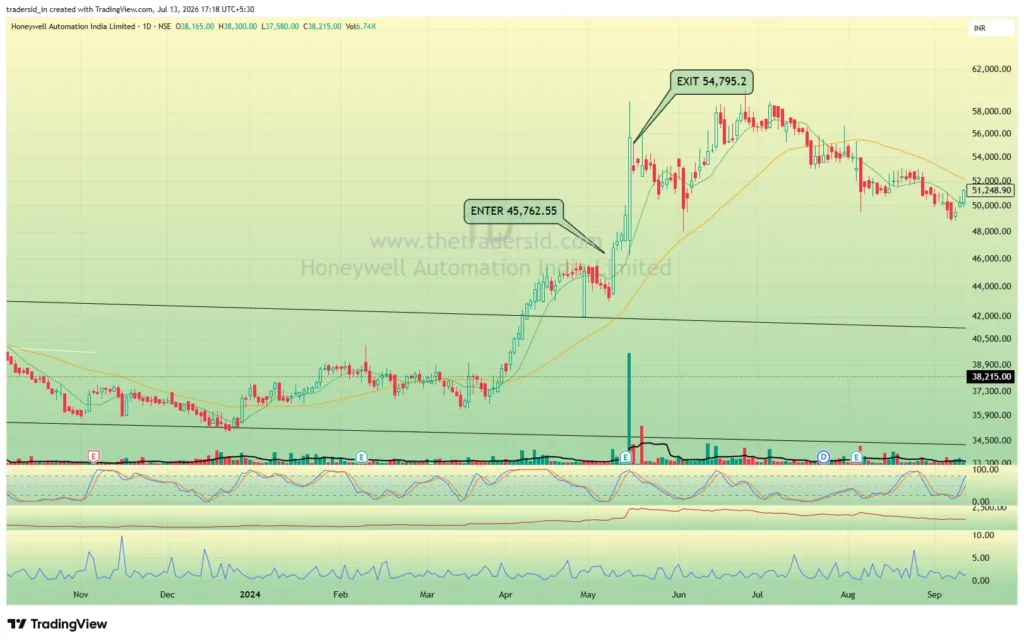
Same note as always on the chart: I didn’t have a saved screenshot from the actual dates of this trade, so the markup here is done on today’s chart, placed at the historical prices and dates from my trade journal.

What I was looking at
HONAUT came up through weekly timeframe analysis, not an alert or a hot tip. I was tracking a breakout on the weekly chart, and one detail stood out before I even got to the breakout itself: the moving averages were sitting close together heading into it. That kind of tightness usually means the stock has been coiling rather than trending cleanly in one direction, and when a genuine breakout comes out of that, it tends to carry more weight than a breakout that happens with the averages already stretched apart.
What I actually did
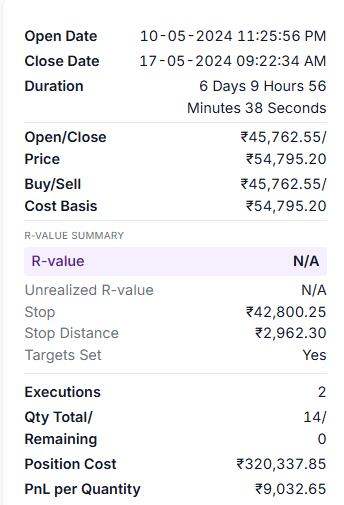
I entered at 45,762.55 with a stop at 42,800.25, giving me a defined risk of roughly 2,962 per share going in. My original profit target was 48,762.55. The stock didn’t just reach that target, it tore straight through it. Six days later, I exited at 54,795.20, well above where I’d originally planned to take profit.
That works out to just over 3R on the trade, held for a little over six days, and a net gain of roughly 63,228 rupees.
Why I exited where I did
This is the part of the trade I actually had to think about. The move happened fast, faster than the setup itself usually plays out, and by the time I was sitting on a 3R gain I had a decision to make: keep holding for more, or take the win in front of me.
I chose to exit. My reasoning at the time was straightforward. A rise that sudden carries real risk of giving back a big chunk of itself just as quickly. I’d already made three times what I was risking, and I wasn’t willing to trade a locked-in 3R for the chance at more, against a real possibility of the stock rolling over hard after a move that fast.
What I’m not claiming here
I want to be honest about something. This wasn’t a scientific exit. I didn’t have a rule that says exit exactly at 3R when the move accelerates past a certain speed. It was a judgment call, made in the moment, based on how the move felt relative to how HONAUT usually trades. It worked out. The stock could just as easily have kept running, and I’d have looked back at this exit as leaving money on the table.
I’m including that because it would be easy to write this trade up as if the exit was obviously correct because the outcome was good. It wasn’t obvious. It was a reasonable decision under uncertainty, and this time the uncertainty broke in my favor.
What this trade taught me
The setup itself, the weekly breakout with converging averages beforehand, did its job. That part of the process worked the way it’s supposed to. The harder skill on display here isn’t the entry, it’s recognizing when a trade has already paid you well and greed is the only thing left pushing you to stay in.
I don’t think the answer is to always exit early once a target is exceeded. Plenty of the best trades keep running long after 3R. But when a move accelerates that sharply, that fast, it’s worth asking honestly whether you’re still trading the setup or just chasing the feeling of a winning position. On this one, I asked that question and got out. I won’t always get that call right, but I’d rather make the decision consciously than let a good trade turn into a round trip because I couldn’t take the win.