This is the twenty-third post in my Real Trade Series, where I go through actual trades from my own charts and journal notes, wins, losses, and everything in between. This one isn’t one trade. It’s two, taken back to back on the same stock, on the same day, after the first one had already lost. I think this is one of the more useful mistakes to write up honestly, because it’s less about a bad setup and more about what happens right after a loss, when the instinct to fix it immediately takes over.
A general note that applies to this post and several others in this series: the open and close dates and times shown come from when the trade was recorded in my trade journal, not necessarily the exact timing the order was actually placed and filled in the market. There can be a gap between the two, and readers should discount the precise timestamps accordingly rather than treating them as a live, tick-by-tick record of execution.
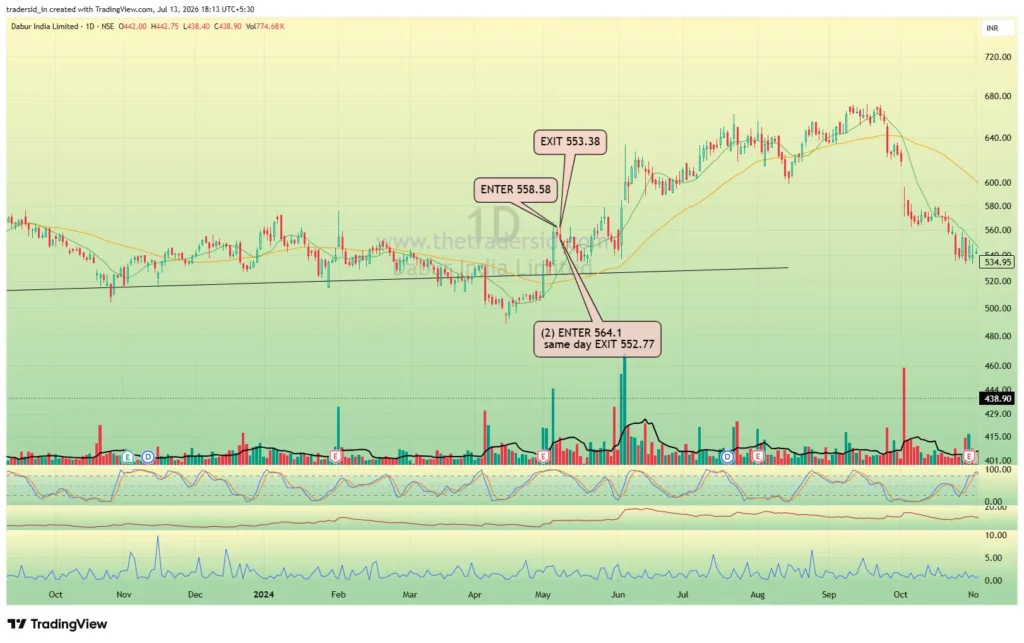
Same note as always on the chart: I didn’t have a saved screenshot from the actual dates of this trade, so the markup here is done on today’s chart, placed at the historical prices and dates from my trade journal.
What I was looking at
Dabur showed up as a potential breakout on the weekly timeframe on 8th May 2024. Looking back at my own notes, I’d flagged two real issues even before entering: the 10 and 50 EMAs were sitting below where the 200 EMA was, and, more importantly, the weekly breakout I thought I was seeing hadn’t actually happened yet. I wrote both of those observations down myself, and I entered anyway.
The first entry
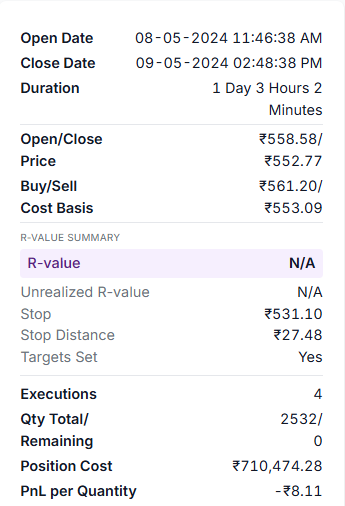
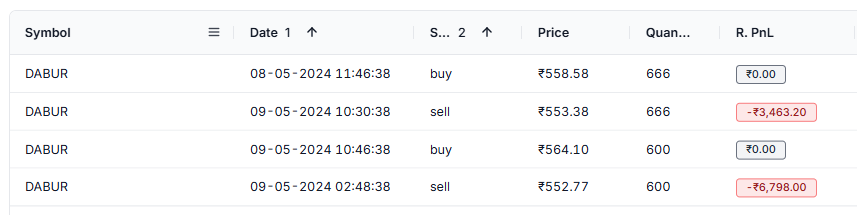
I bought 666 shares at 558.58, with a stop at 531.10, a stop distance of roughly 27.50. The very next day, I exited at 553.38. That trade lost 3,463.20 rupees. Not a large loss on its own, and not far outside what a normal stop-out looks like.
The second entry
Here’s where this trade stops being a normal write-up. Later that same day, roughly sixteen minutes after closing the first position, I bought Dabur again. This time 600 shares at 564.10, a worse price than my first entry. Just a few hours later, I closed that position too, at 552.77. That second leg lost 6,798 rupees, nearly double the first loss.
Between the two entries, this single idea on Dabur cost just over 10,260 rupees in a single day.
Why I went back in
I don’t have a note explaining the second entry the way I do for the first. That absence is itself the honest answer. The first trade had already told me the idea wasn’t working, on the same day, on the same stock, with the same weekly breakout that I’d already flagged as unconfirmed before I ever bought the first time. Going back in at a worse price a few hours later wasn’t a new piece of analysis. It was, as best I can reconstruct it now, an attempt to get back what the first trade had just taken, on a setup I’d already written down as questionable before either entry happened.
What was actually missing
The real mistake here isn’t really about EMAs or breakout timing, even though both of those were genuine red flags I’d noted and ignored. The deeper issue is what happened between the two trades. A loss on a setup I already had doubts about should have been the end of the day for that stock, not an invitation to re-enter at a worse price a few hours later. The second trade wasn’t a fresh read of the chart. It was a reaction to the first loss.
What this trade taught me
A stop-out on a setup I already had reservations about is information, not just a loss to recover from. If my own notes are telling me the breakout hasn’t confirmed and the moving averages aren’t aligned the way I want, and the trade then loses, the right response is to step back, not size back in a few hours later at a worse entry. The second loss on this one wasn’t a market problem. It was a discipline problem, and it cost roughly twice what the first, more forgivable mistake did. That gap between the two losses is the real lesson here, not the setup itself.