This is the twenty-fourth post in my Real Trade Series, where I go through actual trades from my own charts and journal notes, wins, losses, and everything in between. This one is a win, and unlike a couple of the other trades in this series, the setup itself was genuinely solid going in. What makes it worth writing up isn’t a mistake in the entry logic. It’s a question I asked myself in my own notes, on the day I entered, and never actually answered before I acted on it. I think that’s a more common failure than a bad setup, and a harder one to catch, because the trade still works out fine on the surface.
A general note that applies to this post and several others in this series: the open and close dates and times shown come from when the trade was recorded in my trade journal, not necessarily the exact timing the order was actually placed and filled in the market. There can be a gap between the two, and readers should discount the precise timestamps accordingly rather than treating them as a live, tick-by-tick record of execution.
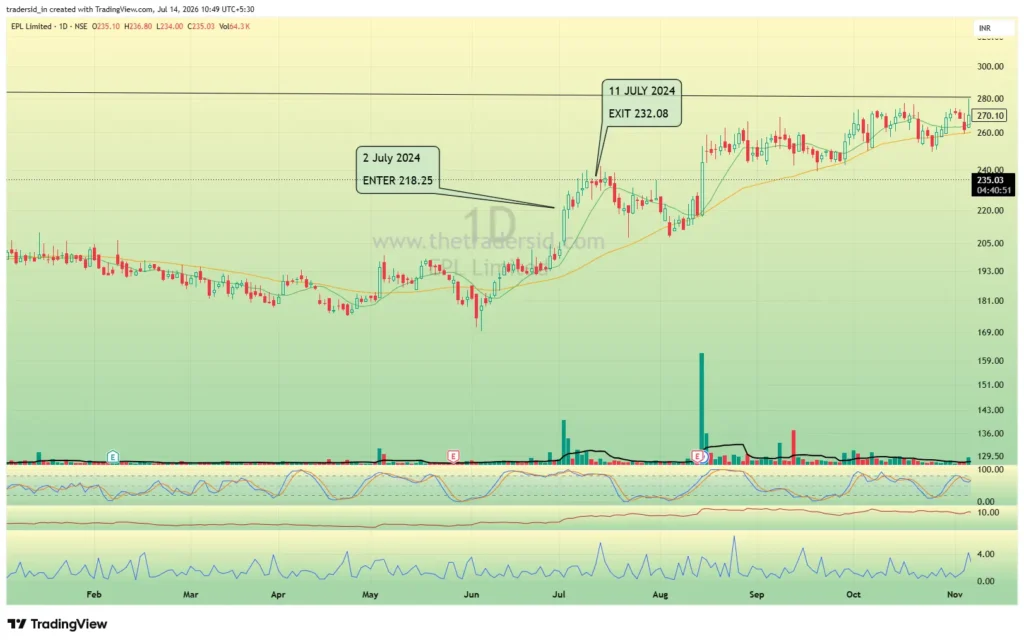
A quick note on the chart below: I didn’t have a saved screenshot from the actual dates of this trade, so the markup is done on today’s chart, with the entry and exit placed at the historical prices and dates pulled straight from my trade journal.

What I was looking at
EPL came onto my radar in early July 2024, and the setup, at least on paper, was about as clean as they come. Looking at my notes from the day, I’d confirmed a breakout on the weekly timeframe and the daily timeframe at the same time, and the stock was also clearing its 200 EMA in the same move. That’s a meaningful confluence. Most of the trades I write about in this series have one or two things going for them. This one had three separate technical signals lining up together, which is close to the ideal version of what I’m actually scanning for before I take a position.
The chart backs this up clearly when I look at it now. EPL had spent most of the prior six months in a slow, grinding base below 200, chopping around without much direction, with price weaving above and below both moving averages. Then, heading into late June and early July, the stock started to lift off that base with real conviction, moving cleanly above both averages and finally through the 200 EMA on volume that stood out from the noisy, low-conviction trading that had defined the months before it. That’s exactly the kind of transition from a range into a trend that a breakout setup is supposed to capture.
What I actually did
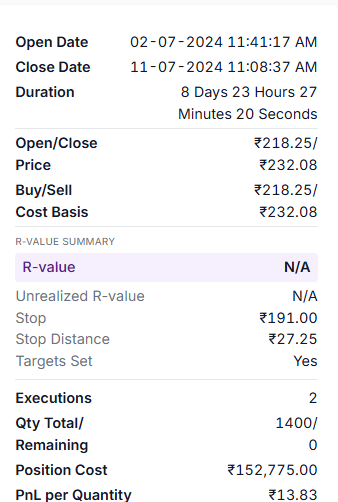
I entered on 2nd July 2024 at 218.25, with a stop placed at 191, which gave me a defined risk of 27.25 per share, a little over 12% below my entry. I also had a profit target set at 246.25 before I ever entered, which works out to roughly 1R above my entry price. That’s a reasonable, fairly standard risk-reward setup for the kind of breakout trade I run.
I held the position for just under nine days. On 11th July, I exited at 232.08, short of my 246.25 target, for a gain of 13.83 per share. In R terms, that’s roughly 0.5R, about half of what I’d originally planned to capture if the trade had run to target. The trade closed for a net gain of 9,281 rupees after costs, a real win, just a smaller one than the plan called for.
The question I left myself
Here’s where this trade stops being a routine, forgettable win. In my notes from the entry day, right after writing down the breakout confirmation across both timeframes and the 200 EMA clearance, I added a second line. I asked myself directly: did I enter at the high because the stock was already up 7.5% for the day?
I want to sit with that question for a moment, because I think it’s an important one and I didn’t actually answer it before I acted. The setup itself, weekly and daily breakout plus clearing a long-term moving average, was real. I’m not second-guessing that part. But confirming that a setup is genuine and confirming that the specific price I’m paying to get into it is a good one are two separate checks, and I only did the first one properly. A stock that’s already up 7.5% intraday by the time I’m clicking buy means I’m paying a price that’s already moved a meaningful amount within that single session, even if the multi-day and multi-week structure behind it is completely sound.
This is a subtler version of a mistake I’ve made more directly in other trades in this series. With GHCL, I chased a stock that was already up 8% for the day and it turned into a loss. Here, the underlying setup was strong enough that chasing the intraday move didn’t sink the trade. But the instinct behind both entries was the same, seeing a stock already extended for the day and buying anyway rather than waiting for a better entry or accepting I might miss it.
Why this one still worked, and what it might have cost me
I don’t think this trade belongs in the same category as BASF or Dabur, where the process was genuinely absent or where I re-entered a setup that had already failed once. The thesis behind EPL was sound, and the trade was profitable. But looking at the chart now, EPL didn’t stop running after I exited on 11th July. It kept climbing through August, paused, then continued into a longer uptrend that carried it well past my original 246.25 target, up toward the 270 to 280 range by October and November.
That’s a real cost, even if it doesn’t show up as a loss in the trade log. Exiting at 232.08, roughly 20% below where the stock eventually traded a few months later, is at least worth asking about in the same honest way I asked about the entry. I don’t have a note explaining the exit decision the way I do for the entry, which means I can’t say with certainty that the extended entry and the early exit are directly connected. It’s possible I exited for an unrelated reason, market conditions that day, a stop adjustment, simple profit-taking discipline. But the two details, an entry I flagged as potentially chasing strength, and an exit that came in well under both my stated target and where the stock eventually traded, sit close enough together that ignoring the connection would be more comfortable than honest.
What was actually missing
If I’m being precise about it, nothing was missing from the setup confirmation itself. The breakout was real, the moving average clearance was real, and the multi-timeframe alignment was exactly what I look for. What was missing was a second, separate check on entry price quality, treating “is this a good setup” and “is this a good price to buy that setup at right now” as two different questions that both need answers before I act, not one question that automatically answers the other.
What this trade taught me
A confirmed setup across multiple timeframes is still worth taking, and I’d take this exact setup again without hesitation. That part of the process worked. But the question I wrote down and didn’t answer is precisely the kind of thing that needs resolving before the entry, not noticed afterward in a journal entry I’m only reading back months later while writing this post. If a stock is already up meaningfully for the day when I’m about to buy, that’s worth a genuine pause regardless of how clean the broader technical picture looks, because I’m no longer choosing my price, I’m accepting whatever price the day’s momentum has already produced.
This trade made money, and by most measures it should count as a clean win. I’m publishing it anyway, because a win that still contains an unresolved question is more useful to look back on honestly than a win that gets filed away simply because the outcome was positive. The next time I catch myself writing down a doubt about entry timing in real time, the goal is to actually resolve it before I act, not just note it down and move on the way I did here.