This is the ninth post in my Real Trade Series, where I go through actual trades from my own charts and journal notes, wins, losses, and everything in between. This one is marked differently in my own notes than the others, not as a loss but as a fail, and I think that distinction is worth explaining.
Most of the trades in this series played out over a few days before I closed them. This one didn’t get that long. I entered and exited Glaxo SmithKline on the same day, 1st September 2023, and the whole thing was over before the trading day even ended.
The setup
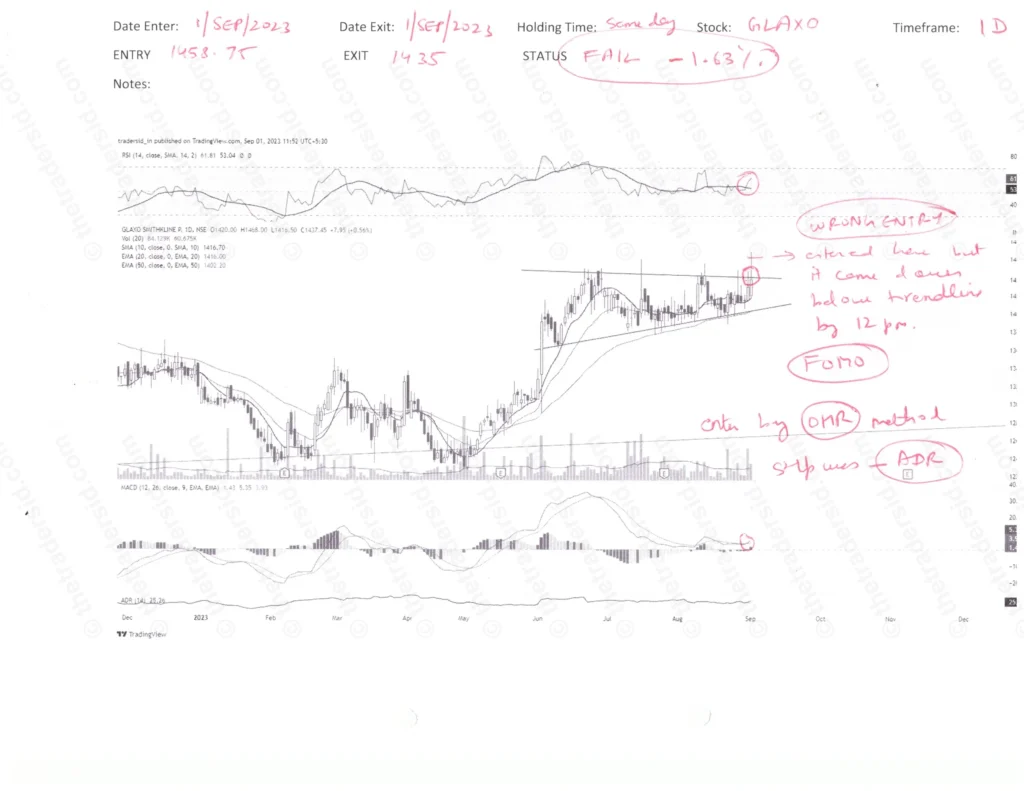
Glaxo had spent months building a long, rounded recovery on the daily chart, climbing steadily from the lows of the previous year through most of 2023. By late August, price had pushed up into a rising wedge, a pattern where price is grinding higher but the range between support and resistance is narrowing. This kind of pattern often resolves with a breakout, and price had pushed right up near the top of that wedge heading into my entry.
I entered at 1458.75.
What went wrong, and how fast it went wrong
My own note here doesn’t leave much room for interpretation. I wrote wrong entry, and right next to it, I explained exactly why. I entered at a certain point, and the stock came down below the trendline it had broken out from by 12pm the same day. This wasn’t a trade that slowly drifted against me over a few sessions. It failed within hours.
I also wrote FOMO next to this entry, the same word that shows up in several other trades in this series. And I noted something specific about my process here that’s worth sitting with. I wrote that entry should be by the OHR method, and that my stop was based on ADR, average daily range. The implication in my own note is that I didn’t actually follow that process on this trade. I got in on a breakout that looked ready to run, without the entry actually being confirmed by the method I use for this kind of setup.
Why same day failures are their own category
I think it’s worth treating this trade as a slightly different category from the other losses in this series. A trade that takes two or three days to prove itself wrong gives you time to notice weakening signals along the way, RSI rolling over, MACD losing steam, price failing to follow through. A trade that fails within the same session doesn’t give you any of that. Either the breakout has real force behind it from the first candle, or it doesn’t, and you find out very quickly which one it was.
That’s exactly what happened here. Price broke above the wedge, I entered believing the breakout was real, and within hours it fell back below the trendline it had just broken out from. There wasn’t a slow unraveling to watch and react to. It just failed.
This is actually useful information about the setup type itself, not just about this one trade. Wedge breakouts on stocks that have already had a long, grinding run up into resistance can fail very quickly if the breakout isn’t backed by real conviction. There’s often not much time to reassess once you’re in, which makes getting the entry right in the first place even more important than it would be on a setup that typically takes a few days to confirm or fail.
What the OHR and ADR notes actually mean for this trade
The reason I wrote out my entry and stop methodology directly on this chart, rather than just noting the outcome, is that I think the real mistake here is procedural rather than about reading the chart wrong. I saw a breakout, got excited about it given how long the stock had been building toward this level, and entered without running it through the OHR method I use to confirm entries, and without properly anchoring my stop to ADR the way I’m supposed to.
When I skip the actual process and enter on a chart pattern alone, I’m removing the exact checks that are designed to filter out entries like this one, entries that look compelling on the daily chart but don’t actually have follow through once you’re in the trade.
What I take from this
The loss itself was small, just under two percent, and the trade was closed out the same day it was opened, so there wasn’t much time for the mistake to compound. But I think this is one of the more important entries in this series precisely because of how clearly it shows the cost of skipping process under FOMO, even briefly.
I already had a method for entries, OHR, and a method for stops, based on ADR. This trade didn’t fail because those methods don’t work. It failed because I didn’t use them, and the market gave me an answer within hours rather than days. That’s a fast, relatively cheap way to be reminded why the process exists in the first place, and I’d rather take reminders like this one seriously now than need a more expensive version of the same lesson later.