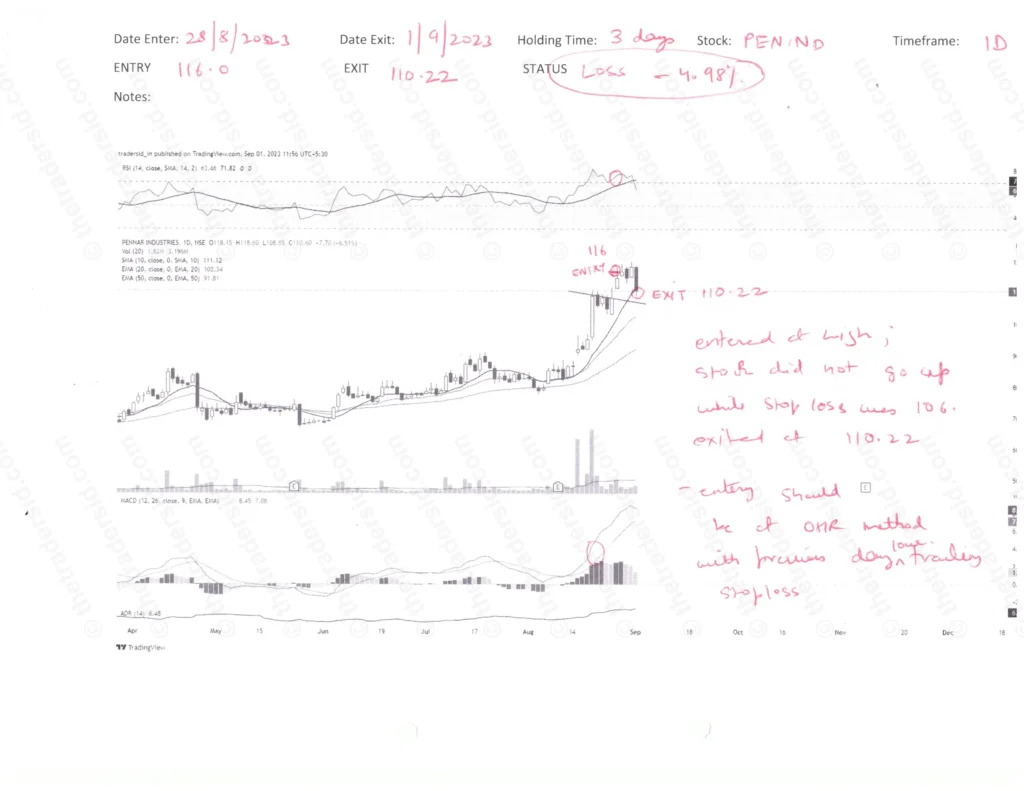
This is the eighth post in my Real Trade Series, where I go through actual trades from my own charts and journal notes, wins, losses, and everything in between. This one is the largest loss in the series so far, and the cause comes down to two decisions made at entry that compounded each other.
Pennar Industries had a sharp, fast move in the days leading into this trade. Looking at the daily chart, the stock had been building slowly for months, then accelerated hard through late August 2023, pushing from around 90 up past 116 in a short stretch. That kind of acceleration is exciting to watch, and it’s also exactly the environment where entry mistakes are easiest to make, because everything is moving fast and there’s very little time to think carefully about where you’re actually getting in.
Where I entered
I entered on 28th August at 116, and my own note explains the problem plainly. I entered at the high. Not at a pullback, not at a breakout retest, right at the high of the recent move, in a stock that had already run hard to get there.
Entering at the high isn’t automatically wrong. Plenty of good trades are entered near a stock’s recent high, especially in a strong trend. The problem here was what came next.
The stop loss decision
My stop loss was placed at 106, ten rupees below my entry of 116. On a stock trading around that level, that’s a meaningful amount of room, but the note I left for myself is the important part. I wrote that the stock did not go up while the stop loss was sitting at 106. In other words, price never gave me the follow through I was expecting, it just drifted without conviction, and I was carrying a fairly wide stop the entire time waiting for a move that wasn’t coming.
I exited three days later, on 1st September, at 110.22. That’s a loss of just under five percent, by some distance the largest loss in this series so far.
Why this one hurt more than the others
The size of this loss compared to the others in this series isn’t really about the setup being worse than, say, the Mazagon Dock or Engineers India trades. It’s about the stop loss methodology. In those earlier trades, tight stops kept the damage small even when the entry itself was flawed. Here, the stop was far enough away that a bad entry had much more room to actually cost real money before it triggered.
My note on this trade points directly at the fix. I wrote that entry should be based on the OHR method, using the previous day’s low or trailing stop loss, rather than an arbitrary distance below entry. This is a meaningfully different approach from what I actually did. Instead of picking a stop loss level and asking whether the resulting risk made sense, I picked an entry near the high and then placed a stop that happened to be ten rupees away, without that distance being tied to any specific structural level on the chart.
What entering at the high actually costs you
There’s a mechanical reason entering at the high combined with a stop that isn’t tied to structure is particularly costly. When you enter near a recent high, you’re by definition entering at the point with the least room below you before you hit meaningful support. If your stop loss isn’t anchored to an actual level, like the previous day’s low, you end up either placing it too close, where normal volatility shakes you out, or too far, where you’re absorbing a large loss before the trade is technically proven wrong.
In this trade, I ended up in the second situation. Ten rupees of room might sound reasonable in isolation, but without it being tied to an actual support level or a previous day’s low, it was really just an arbitrary number that happened to define how much I was willing to lose before admitting I was wrong.
What I take from this trade
The lesson here is more specific than most of the earlier posts in this series, and I think that specificity is useful. Stop loss placement shouldn’t be a round number or a comfortable feeling distance from entry. It should be tied to an actual price level that, if broken, tells you clearly that the trade thesis is no longer valid. My own note names this directly, using the previous day’s low as the reference point for the stop, rather than picking a number that simply felt far enough away to avoid getting stopped out on normal noise.
Entering near a recent high isn’t inherently a mistake, but it raises the bar for how carefully the rest of the trade needs to be managed. There’s less room for error built into the entry itself, so the stop loss and the read on whether the stock is actually following through both need to be sharper than they would in a trade entered further from a recent high.
What I’d do differently
Going forward, the specific change here is using the OHR method I referenced in my own notes, setting stops based on the previous day’s low or a proper trailing stop tied to actual price structure, instead of a fixed rupee distance chosen somewhat arbitrarily. I’d also want to see the stock actually show some follow through relatively quickly after an entry near the high. If price just sits there without moving in my favor for several days, the way Pennar Industries did here, that itself is information worth acting on rather than waiting for the wider stop to eventually get hit.
This trade cost more than any other in this series so far, and I think that’s precisely because the stop loss wasn’t doing the job a stop loss is supposed to do, defining risk based on where the setup is actually wrong, not just based on a number that felt acceptable at the time.