This is the tenth post in my Real Trade Series, where I go through actual trades from my own charts and journal notes, wins, losses, and everything in between. After a run of losses in this series, this one’s a win, and a good one. But I want to be honest that even here, my own notes flag something I’d do differently.
Birla Cable is the first outright win I’ve written about in this series, and it’s worth spending time on, not just because it worked, but because of what my own notes say about how I exited it.
The setup
Birla Cable had a long, quiet base building through most of 2023, trading in a fairly tight range for months before starting to show real strength heading into September. Looking at the daily chart, the stock had been consolidating for a long stretch, then broke into a clean rising pattern, higher lows tightening into a triangle right before the move I actually traded.
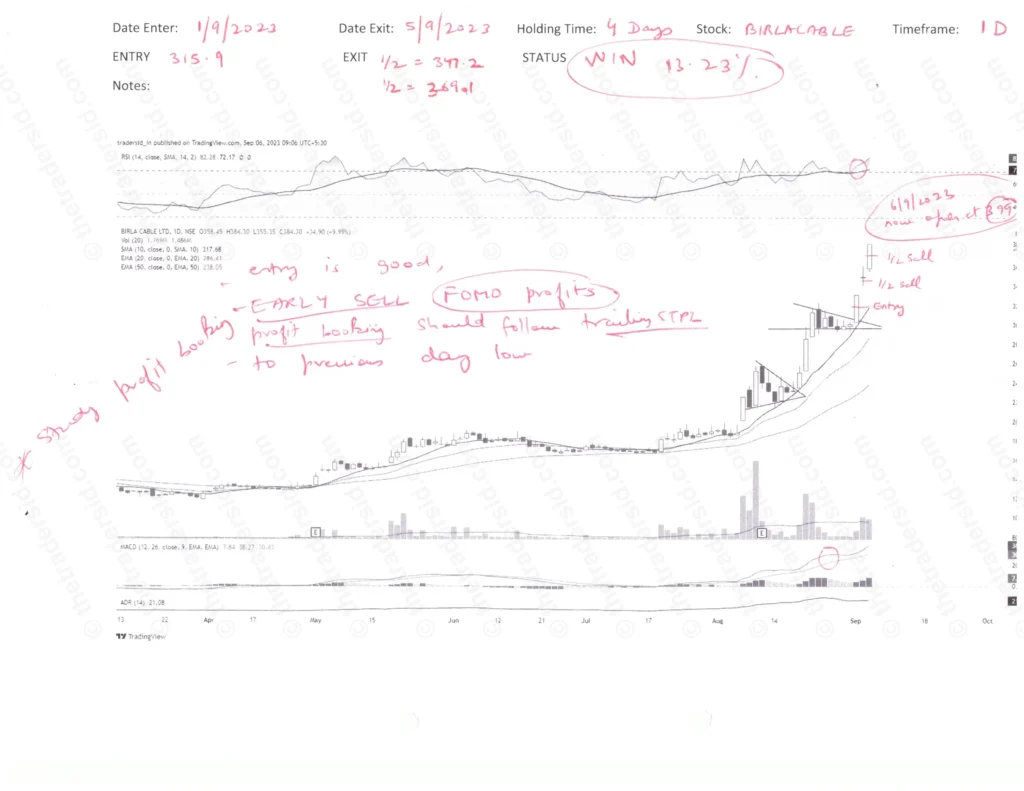
I entered on 1st September at 315.9. My own note here is short and direct: entry is good. Unlike several of the trades earlier in this series, there’s no FOMO flag next to the entry itself, no note about a missing confirmation or an unconfirmed close. This was a clean, well timed entry into a setup that had actually formed properly.
How I exited
I sold in two parts. Half my position went at 347.2, the other half at 369.1. Four days after entry, on 5th September, the trade was closed with a gain of 13.23 percent. By any measure, that’s a strong result, and it’s the best outcome of any trade in this series so far.
But here’s where it gets interesting. Right next to the win, I wrote early sell. And on 6th September, the day after I’d fully exited, I noted that the stock opened at 399. I’d already sold my second half at 369.1 the day before.
The gap between a win and the full win
This is a useful thing to sit with. The trade was genuinely a win, entry was clean, the pattern played out, and I walked away with a solid gain. But my own notes are clear that I left more on the table than I needed to. The stock continued higher the very next morning, gapping up to 399, well above where I’d sold my final portion.
I wrote out the actual lesson directly on the chart, and I think it’s worth quoting close to how I phrased it. Profit taking should follow a trailing stop loss, tied to the previous day’s low, rather than fixed targets decided in advance. I also wrote FOMO profits next to this, which is an interesting flip on how I’ve used that word elsewhere in this series. In most of these posts, FOMO describes entering too early or too eagerly. Here, it’s describing the opposite mistake, selling too eagerly because the gain already felt good enough to lock in, rather than staying with a trailing stop and letting the trend actually tell me when to get out.
Why exiting early isn’t the same mistake as the trades that lost
I want to be clear that this isn’t the same category of mistake as the FOMO entries or wide stops in earlier posts in this series. Those trades lost money because of process failures at entry. This trade made real money because the entry and the read on the setup were both good. The only thing that could have been better is how much of the move I actually captured, which is a completely different problem to have than the ones in the rest of this series.
Still, I think it’s worth writing about honestly, because a trading journal that only flags losses and skips over the imperfections inside wins isn’t giving me the full picture. This trade worked. It could have worked even better if I’d managed the exit differently.
What I take from this trade
The specific note I left myself is the actual takeaway here, and I want to keep it close to how I originally wrote it. Profit taking should follow a trailing stop loss based on the previous day’s low, not a fixed target chosen ahead of time. Fixed targets have a real benefit, they take emotion out of the exit decision and guarantee you lock in a gain once price gets there. But they also cap the trade at a number you decided before you actually knew how strong the move would turn out to be.
A trailing stop tied to the previous day’s low would have kept me in this trade through the continued strength, only forcing an exit once the stock actually showed signs of reversing, rather than me deciding in advance that a certain percentage gain was good enough to take.
Why I’m marking this one down as a study trade
I actually wrote study on this chart, off to the side, and I think that’s the right way to think about this trade going forward. It’s not a mistake to fix the way the losing trades in this series are. It’s a genuinely good trade that still has a lesson buried inside the win. Those are worth revisiting just as much as the losses, maybe more, because it’s easy to look at a winning trade, feel satisfied with the outcome, and never go back to ask whether the win could have been managed even better.