This is the fifteenth post in my Real Trade Series, where I go through actual trades from my own charts and journal notes, wins, losses, and everything in between. This one is a same day loss, and unlike the panic selling posts earlier in this series, this trade actually came from a real observation about the chart. The problem was in how I acted on it, not in whether I was paying attention.
Coal India is a useful trade to place right after the RITES post, because it shows that even a technically grounded reason for exiting can still lead to a bad outcome if the underlying read on the situation isn’t quite right.
The setup
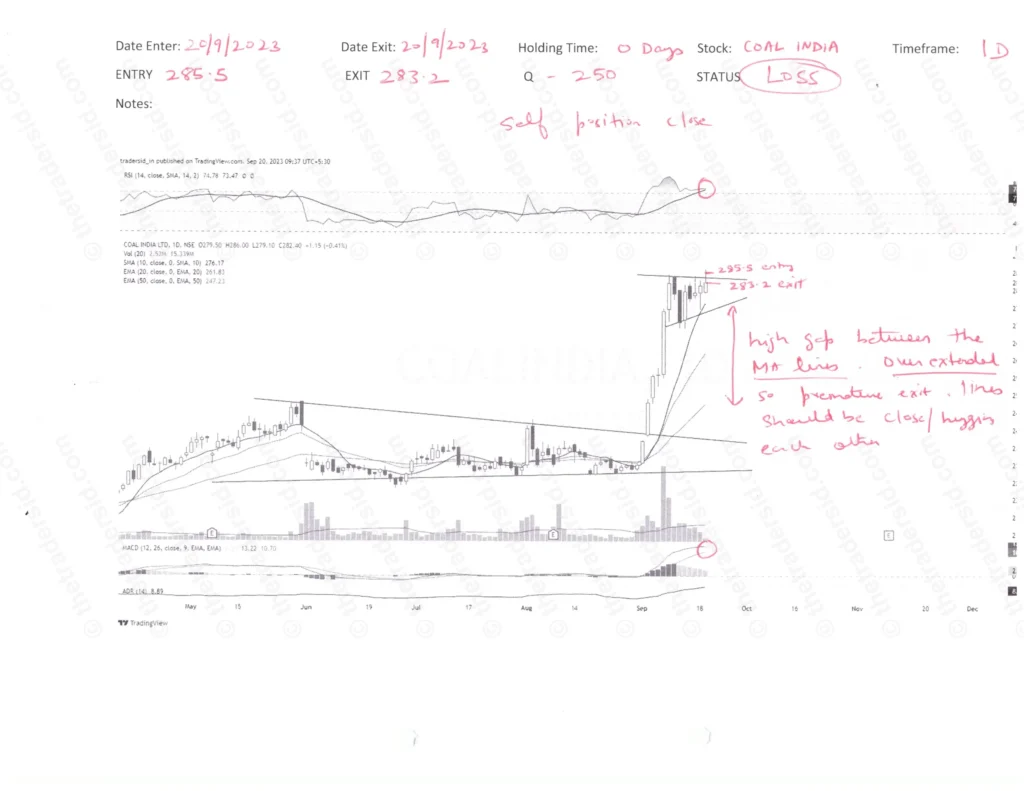
Coal India had spent months building a long base through the middle of 2023, trading in a fairly tight range from around May through August before breaking out sharply in September. The move once it started was fast, price pushed from around 200 up past 285 in a short stretch, well above its rising moving averages.
I entered on 20th September at 285.5, with a quantity of 250 shares.
What happened next
This trade didn’t last the day. I exited the same session, at 283.2, a small loss. My note describes this as a self position close, meaning this wasn’t a stop loss getting triggered by the market. I made an active decision to get out.
The reasoning behind that decision is written clearly on the chart. I noted a high gap between the moving average lines, describing the stock as overextended, and concluded that this justified a premature exit.
Why “overextended” wasn’t quite the right read here
I want to be fair to myself here, because this wasn’t a panic decision the way JSW Energy or Ashapura Minechem were. I was looking at something real, a wide gap between price and its moving averages, which is a legitimate thing to be cautious about after a fast move. Extended stocks do pull back, sometimes sharply, and closing a position because of that risk is a defensible instinct.
But my own follow up note is the most useful part of this entry, and I want to keep it close to how I wrote it. I noted that the exit should be based on price closing or breaking each of the moving averages, one at a time, rather than exiting simply because the gap between price and those averages looked wide in the moment.
This is a meaningful distinction. Looking at a chart and deciding a stock looks stretched is a subjective, all at once judgment. Waiting for price to actually close below the 10 EMA, then the 20 EMA, then the 50 EMA, one level at a time, is a specific, sequential process that gives the stock room to still be in a valid uptrend even while it’s extended. An extended stock isn’t automatically a stock that’s about to reverse. It’s a stock that has moved a lot recently, which is a different thing.
Connecting this to the RITES trade
This is worth reading alongside the RITES post directly before it in this series. In that trade, I exited because price had actually broken below the 10 and 20 EMA, with a real risk of breaking the 50 EMA too, a sequence of concrete technical developments. In this trade, I exited because the stock looked stretched relative to its moving averages, without actually waiting to see if or how it would interact with those same levels.
Both exits were reasoned, in the sense that neither one was pure panic. But only one of them was based on price actually doing something, rather than on how far price had already moved. The Coal India exit was closer to predicting a pullback than reacting to one that had actually started.
What I take from this trade
The lesson here is specific and, I think, genuinely useful going forward. Being extended relative to moving averages is a reason to pay closer attention, not a reason to exit on its own. The actual trigger should be price closing below those averages in sequence, which is exactly the fix I wrote down for myself on this chart. Close or break each moving average one at a time, and let that sequence, not the visual gap alone, decide when to exit.
I think what happened here is that I applied a legitimate observation, the stock is extended, using an exit method better suited to a different situation, treating extension itself as the trigger rather than treating an actual break of support as the trigger. Both RITES and Coal India involved me watching moving averages closely. Only one of them involved me waiting for those averages to actually confirm something before acting.
What I’d do differently
Going forward, when a stock I’m holding gets visibly extended above its moving averages, I want to treat that as a cue to watch the 10, 20, and 50 EMA more closely and more frequently, not as a signal to exit immediately. The actual exit trigger should still be a real technical event, a close below the nearest moving average, ideally with the same kind of multi candle confirmation I used correctly in the RITES trade, rather than a same day decision based on how far apart the lines on my chart happened to look.
This was a small loss, and I don’t think the underlying concern, that the stock had moved a lot very quickly, was wrong. The mistake was turning a valid observation into an immediate exit instead of a closer, more disciplined watch.