This is the sixteenth post in my Real Trade Series, where I go through actual trades from my own charts and journal notes, wins, losses, and everything in between. This one is the biggest single day win I’ve written about so far, and it ends with a question I wrote directly on the chart that I still think is worth sitting with.
AGI Greenpac gave me one of the sharpest single day moves I’ve traded in this whole series, and unlike some of the earlier posts, this trade actually went right in almost every way. I still want to write about it, though, because of how it ended, and because of a question I asked myself right there on the chart afterward.
The setup
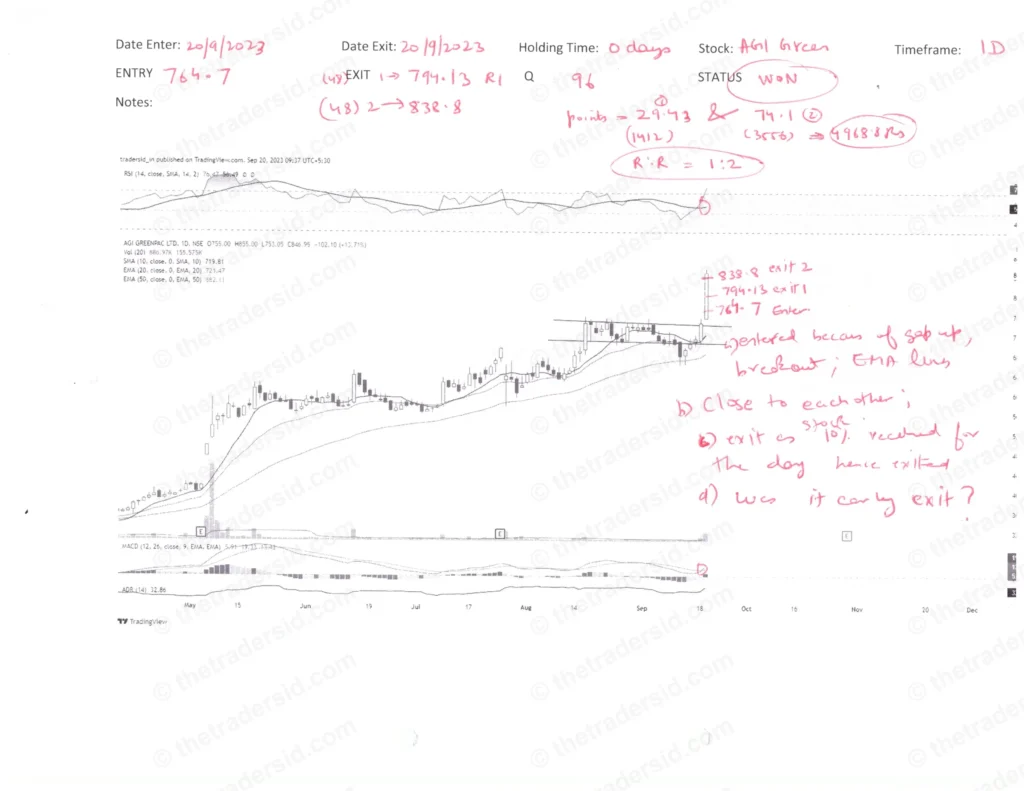
AGI Greenpac had been building a long, steady uptrend through the middle of 2023, climbing from lower levels in April through a series of tight consolidations before pushing into a proper base near its highs by September. On 20th September, the stock gapped up sharply, and I entered the same day at 764.7 with a quantity of 96 shares.
My own note explains what drove the entry clearly. I entered because of the gap up, the breakout, and the moving average lines being close to each other. That last part is worth pausing on. A tight cluster of moving averages, the 10, 20, and 50 all sitting close together, usually signals that a stock has been consolidating in a fairly balanced way before a move, which can make a subsequent breakout more reliable than one that happens when the averages are widely spread apart.
How the exit worked
This trade moved fast. I scaled out in two parts, both on the same day. The first half of my position, 48 shares, was sold at 794.13, capturing 29.43 points per share. The second half, also 48 shares, was sold at 838.8, capturing 74.1 points per share. Combined, this trade produced a profit of roughly 4968.8, an exceptionally strong result for a single session, with the stock itself closing up nearly 13.71 percent on the day. Status: won.
I also worked out the risk to reward on this trade afterward and got 1 to 2, right at the standard I use as my actual minimum for taking a trade in the first place. This wasn’t a trade that just happened to work despite a shaky risk profile, the way the Cochin Shipyard trade was. The numbers here actually supported taking the trade before I ever knew how it would play out.
Why I still wrote a question on this chart
Given all of that, a strong entry reason, a properly scaled exit, a risk to reward ratio that matched my own rule, it would be easy to file this away as an unambiguous success and move on. But I didn’t. I wrote out a short list of reasoning on the chart afterward, and it ends with a genuine question rather than a conclusion. I exited because the stock had received its ten day move for the day, as I put it, and then I asked myself directly, was it an early exit?
I think this is worth including honestly rather than editing it into a cleaner narrative than it actually was. The stock had moved an enormous amount in a single session. My reasoning for taking the second exit was that the stock had already delivered what I judged to be its expected move for the day, which is a reasonable thing to base an exit on. But I wasn’t fully convinced even in the moment, and I wrote that uncertainty down rather than pretending I was sure.
Why this uncertainty is worth keeping in the record
I think there’s a real temptation, especially on a trade that made this much money, to look back and simply be satisfied with the outcome without asking whether the exit was actually well timed relative to how much further the stock could have run. A win this large can make the underlying question feel unimportant, since the trade worked out well regardless of the answer.
But the question I asked myself, was it an early exit, is exactly the kind of question that’s more valuable to ask on a winning trade than a losing one. On a loss, the outcome itself tells you something went wrong. On a big win, the outcome can quietly discourage you from examining whether the process could have captured even more, the same blind spot that showed up in the Birla Cable trade earlier in this series, just at a much larger scale here.
What I take from this trade
I don’t think I have a clean answer to the question I left myself, and I don’t think I need to force one. What I do think is worth carrying forward is the habit itself, taking a big win and still asking honestly whether it could have been managed even better, rather than only running that kind of review on trades that lost money. The entry process here was sound. The risk to reward was sound. Whether the exit captured the full move available is a genuinely open question, and I’d rather leave it open and revisit similar setups with that question in mind than manufacture a false sense of certainty about it now.
What I’d carry into future trades like this one
Looking at this alongside the other exit related posts in this series, RITES, JSW Energy, Ashapura Minechem, and Coal India, I think this trade adds a useful new angle. Those posts were mostly about avoiding premature exits driven by panic or an overly cautious read of an extended stock. This one is about a large, fast moving trade where the exit reasoning was sound but the scale of the move makes me want to specifically study whether a partial trailing exit, letting a portion of the position ride further with a trailing stop instead of a full exit at a fixed point, would have captured more of a move like this one without giving up the discipline that made this trade work in the first place.