This is the seventh post in my Real Trade Series, where I go through actual trades from my own charts and journal notes, wins, losses, and everything in between. This one is a loss, and the lesson in it is a bit more specific than FOMO or a missed close. It’s about which breakout inside a trend you actually choose to chase.
Action Construction Equipment had a strong, steady climb through most of 2023. Looking at the daily chart from March onward, the stock moved from around 300 up past 780 by mid August, a genuinely powerful multi month trend with price staying consistently above its rising moving averages the whole way.
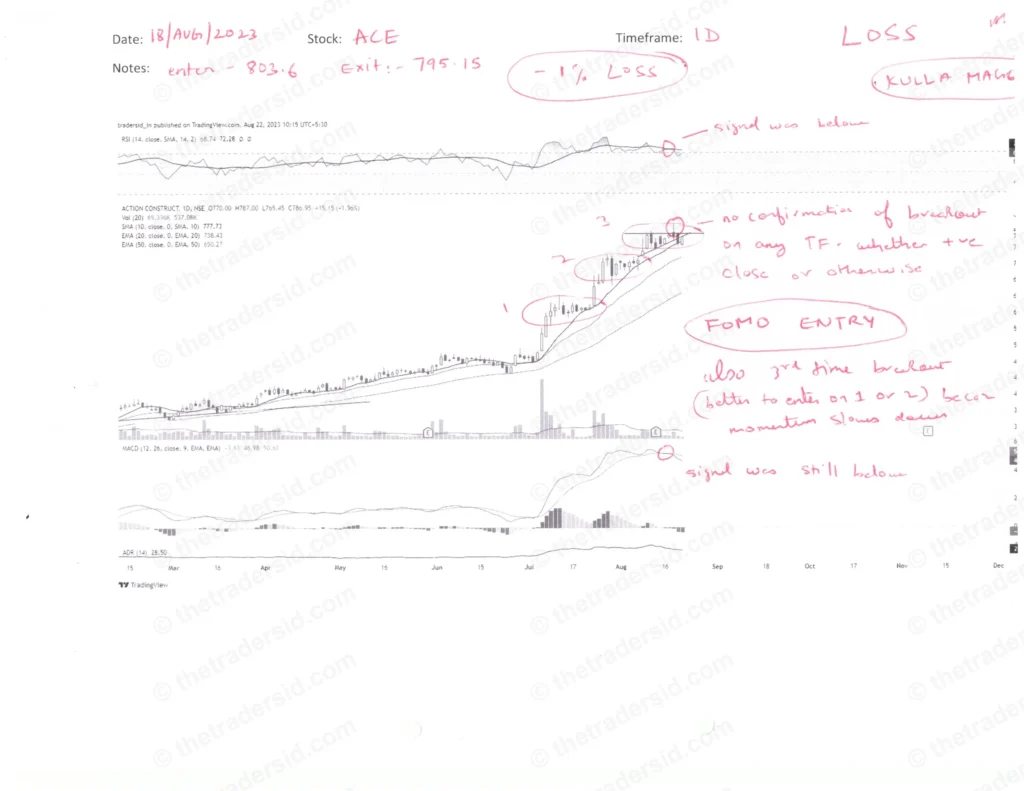
Inside that larger trend, I marked three separate breakout attempts on my chart, numbered one, two, and three, each one a spot where price pushed up out of a short consolidation and tried to continue higher. I entered on the third one, at 803.6, and exited at 795.15, a loss of about one percent.
Why the third attempt was the wrong one
My own notes explain exactly what I got wrong here, and it’s a genuinely useful distinction. I wrote that this was a FOMO entry, and specifically that it was the third time the stock had attempted this kind of breakout. My note says it plainly, it would have been better to enter on the first or second attempt, because by the third attempt momentum was already slowing down.
This is a different kind of mistake than the ones I’ve written about in earlier posts in this series. It’s not that I entered without a confirmed close, although I noted that too, no confirmation of breakout on any timeframe, whether positive close or otherwise. It’s that even if the entry had technically been valid, the third breakout attempt inside the same move is structurally a weaker trade than the first or second one, because each failed or stalled attempt uses up some of the energy that a fresh breakout needs to actually run.
Think about it from the perspective of everyone else watching the same chart. The first breakout attempt draws in buyers who believe the stock is ready to continue. If that attempt stalls, some of those buyers get disappointed and sell into the next rally. The second attempt draws in more buyers, and if that one also stalls, more of the earlier buyers who were hoping for a bigger move start looking to exit on any strength. By the time a third attempt shows up, a meaningful amount of the buying enthusiasm has already been spent on the first two, even though the stock’s overall trend is still intact.
The confirmation issue on top of this
Beyond the timing problem, I also noted that there was no real confirmation of the breakout at the point I entered, on any timeframe I checked, whether the close was positive or not. This stacks directly on top of the sequencing problem. Not only was I entering on the weakest of the three attempts, I was also entering without the basic confirmation I’d normally want to see before getting in at all.
I also wrote that RSI and MACD signals were still below where I’d want them to be at the time of entry, both under my own note “signal was below.” So this wasn’t just a case of poor timing within the pattern. The underlying momentum indicators were telling a consistent story too, and I entered anyway.
What I take from this trade
The specific lesson here is one I think is genuinely underrated compared to more commonly discussed mistakes like chasing extended moves or ignoring stop losses. Not every breakout attempt inside a strong trend deserves the same level of conviction. The first clean breakout out of a proper base usually has the most fuel behind it. Subsequent attempts, especially a third one, need to be treated with real skepticism, not more excitement just because the stock has already proven it can move.
I think there’s a version of FOMO that’s specifically about pattern count rather than just price level. It’s not always about a stock being up a lot and wanting in before it goes further. Sometimes it’s about watching a stock attempt the same kind of move multiple times and feeling like each attempt is another chance you don’t want to miss, when really each failed or stalled attempt should be lowering your conviction, not raising it.
What I’d do differently
Going forward, the rule I’m taking from this is straightforward to state. If I’m looking at a breakout attempt inside an existing trend, I want to know how many times the stock has already tried this same move recently. A first or second attempt, with actual confirmation behind it, deserves real consideration. A third attempt, especially one without a confirmed close and without RSI or MACD support, is exactly the kind of setup where FOMO is doing more of the decision making than my actual process is.
This trade only cost about one percent, which is a small price for a lesson that applies well beyond this one stock. Counting how many times a pattern has already tried and failed is now something I actually want written down as part of my process, not just something I notice after the fact in hindsight.