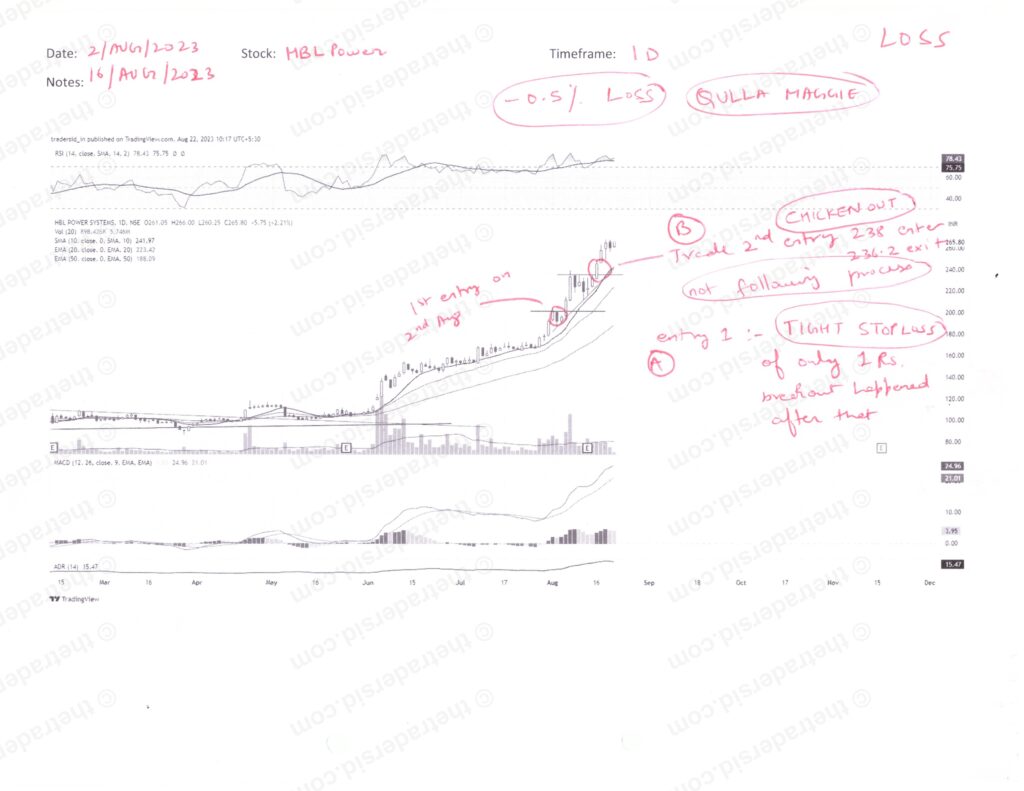
This is the sixth post in my Real Trade Series, where I go through actual trades from my own charts and journal notes, wins, losses, and everything in between. This one is a little different from the others because it’s actually two entries on the same stock, and the mistakes in each one are opposites of each other.
HBL Power is one of those trades where looking back at my own notes tells a more interesting story than the final number does. The overall result was a small loss, half a percent, but that number hides two separate decisions that each taught me something different.
The setup
HBL Power had a strong move building through the middle of 2023. The stock climbed steadily from around 100 in June up toward 260 by August, a genuinely powerful trend with price holding well above its rising moving averages the entire way. This is exactly the kind of stock that produces good entries along the way, small pauses and tight ranges inside a much bigger uptrend, each one offering a chance to get in without chasing the whole move at once.
Entry one, on 2nd August
My first entry came on 2nd August, and my note here is short but says everything. Tight stop loss, only one rupee. I got stopped out, and then, as I wrote directly on the chart, the actual breakout happened right after that.
This is one of the more frustrating things that can happen in trading, and I think it’s worth naming plainly rather than dressing it up. A stop loss that’s too tight isn’t really protecting you from being wrong about the trade. It’s protecting you from ordinary, expected noise, the small wiggles that happen inside almost every setup before it actually moves. One rupee of room on a stock trading around 200 is an extremely small allowance. It doesn’t give the trade any room to breathe before proving itself one way or the other.
I got shaken out, and the stock did exactly what I thought it would do, just a little later than my stop loss was willing to wait for.
Entry two
Watching the move continue without me is its own kind of pressure, and that pressure led directly into the second entry. I got back in at 238, a second attempt at the same underlying idea, just later and at a higher price than the first one.
This entry didn’t work either, and my own notes are unusually blunt about why. I wrote “chicken out” and “not following process” right next to this entry. I exited at 236.2, a small loss on this leg specifically, but the real issue wasn’t the size of the loss. It was that I got out of a trade I had re-entered specifically because I believed in the move, and then abandoned that belief almost immediately once price gave me any resistance at all.
Two mistakes, not one
What makes this trade worth writing about is that the two entries fail in opposite directions. The first entry failed because my stop was too tight and gave the trade no room to be right. The second entry failed because I didn’t actually follow through on my own conviction once I was back in, exiting on what my notes call chickening out rather than any real technical reason.
Both of these come from the same underlying problem, even though they look different on the surface. In both cases, I wasn’t trusting a plan I had already made. On the first entry, the plan was undermined before the trade even had a chance, because the stop was set based on fear of losing rather than based on where the setup would actually be invalidated. On the second entry, the plan was undermined after entry, when a normal amount of price movement was enough to shake my confidence and get me out.
The Qullamaggie note
I also wrote a reference to Qullamaggie on this chart, and I think it’s worth explaining why. His approach to stop losses and position management is something I’ve studied closely, and one thing that stands out in how he talks about tight consolidations inside strong trends is that the stop needs to be placed based on where the pattern is actually invalidated, not based on minimizing rupee risk to the smallest number that feels comfortable. A one rupee stop on this setup wasn’t a technical decision. It was an emotional one, dressed up to look like discipline.
What I take from this trade
This trade is really a lesson in two parts, and I think both parts matter more than the actual half a percent I lost.
The first part is about stop placement. A stop loss needs enough room to let the setup actually prove itself wrong, not just enough room to make me feel like I’m being careful. If I’d given the first entry a more reasonable stop, tied to an actual level of invalidation rather than an arbitrary small number, there’s a real chance I stay in the trade through the noise and catch the breakout that happened right after I was shaken out.
The second part is about conviction after entry. Getting back in at 238 was a reasonable decision on its own. Exiting almost immediately after, without a real technical reason beyond nerves, undid the value of getting back in at all. If I don’t trust an entry enough to let it play out past the first sign of resistance, I probably shouldn’t be taking that entry size, or I need a clearer plan for how much room I’m willing to give it before I actually act on hitting the level, not before.
Half a percent is a small price to have learned both of these lessons on the same stock, in the same week. I’d rather see this pattern clearly now, written down in my own hand, than keep repeating a version of it without noticing.