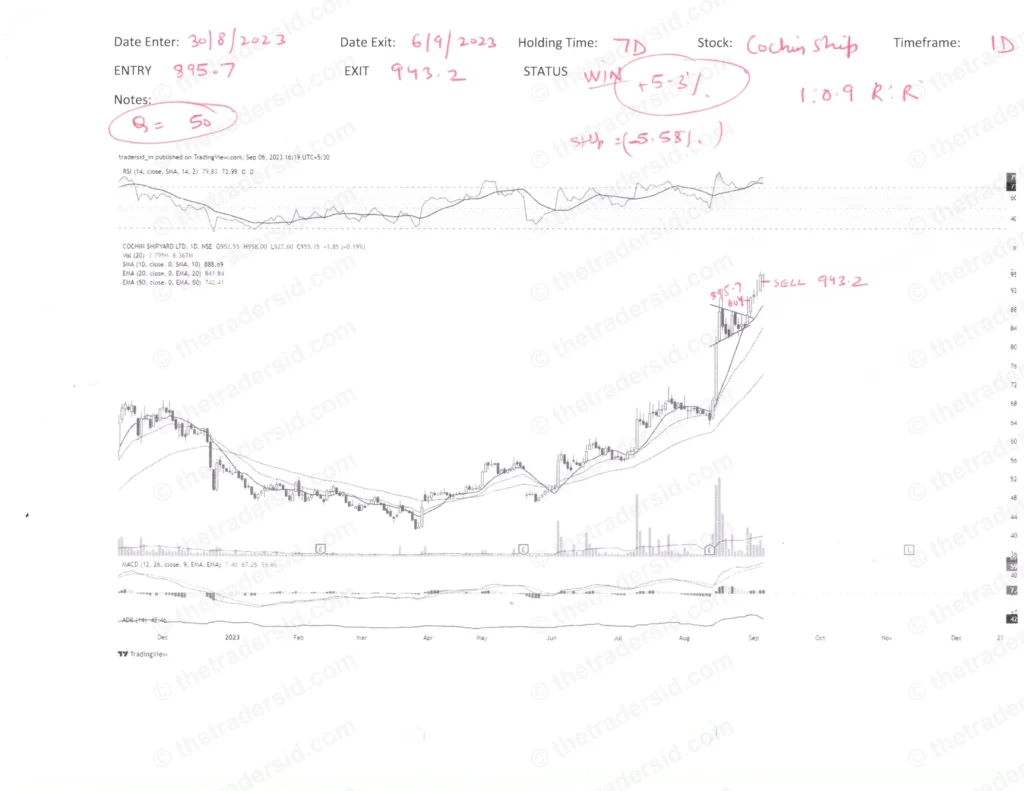
This is the twelfth post in my Real Trade Series, where I go through actual trades from my own charts and journal notes, wins, losses, and everything in between. This one is a win, a solid one, but it’s also a trade that didn’t actually meet my own risk to reward standard, and I think that’s worth talking about honestly rather than just celebrating the result.
Cochin Shipyard is a good example of why I don’t think outcome alone tells you whether a trade was actually well executed. This trade made money. It also broke one of my own rules, and I want to walk through both sides of that.
The setup
Cochin Shipyard had a long, rounded recovery through most of 2023, bottoming out around March and April before beginning a steady climb that accelerated through the summer. By late August, the stock had pushed into a tight rising wedge near its highs, contracting range right before a strong breakout move.
I entered on 30th August at 895.7, with a quantity of 50 shares. Seven days later, on 6th September, I exited at 943.2, a gain of 5.3 percent. Status: win.
The number that actually matters here
On the surface, this looks like a clean, well executed trade. Good entry near a breakout, solid follow through, a real gain over about a week. But I wrote something else on this chart that changes how I think about it. The risk to reward on this trade came out to 1 to 0.9, with a stop loss distance of 5.58 percent.
That number is worth sitting with for a second. My reward on this trade, 5.3 percent, was actually smaller than my risk, 5.58 percent. In plain terms, I was risking slightly more than I stood to gain if the trade worked. This is below the 1 to 2 minimum I use as a standard for taking a trade in the first place, and it’s not even a modest miss. A 1 to 0.9 ratio means I was risking almost exactly as much as I hoped to make, which is a fundamentally different risk profile than what my own checklist calls for.
Why this is worth writing about even though it won
It would be easy to skip past this detail, since the trade worked out and produced a real gain. But I think that’s exactly the wrong instinct. If I only examine trades that lost money, I’m going to miss the pattern where a rule gets broken and the market happens to bail me out anyway. Those trades feel fine in the moment because the outcome was good, and that feeling is precisely what makes them dangerous to repeat.
A 1 to 0.9 risk to reward setup, taken repeatedly, is not a good long term strategy even if any individual instance of it happens to work. Over enough trades, taking setups where you’re risking as much or more than you stand to gain is a losing proposition on average, even if this specific one landed in my favor.
What likely happened here
Looking back at the setup, I think what happened is that the stop loss placement, tied to the width of that wedge pattern near the highs, ended up being wider than the actual target I was working with. The wedge itself wasn’t very large in percentage terms relative to how tight I needed my stop to be to protect against a false breakout. That combination, a stop that needs real room and a target that isn’t much further away, is going to naturally produce a weak risk to reward ratio, even when the setup itself looks clean on the chart.
This is a useful thing to catch before entry rather than after. If I’d run the actual numbers, entry at 895.7, a stop loss roughly 5.58 percent below that, against a realistic target only slightly further away than the stop, I would have seen the 1 to 0.9 ratio before ever placing the trade, not after calculating it in hindsight.
What I take from this trade
The lesson here isn’t really about Cochin Shipyard, the stock, or wedge patterns specifically. It’s about actually running the risk to reward math before entry, not just checking whether the pattern looks good. A clean looking chart pattern can still produce a poor risk to reward ratio depending on where the stop needs to sit and how far away a realistic target actually is.
I got a good outcome on this trade, but I don’t want to let that outcome quietly excuse the process. If I take enough setups with a 1 to 0.9 ratio, the wins won’t be enough to offset the losses over time, even if each individual trade looks fine on its own. My own rule of a 1 to 2 minimum exists precisely to filter out trades like this one before they happen, not to be checked against afterward once the outcome is already known.
What I’d do differently
Going forward, this is a straightforward discipline check rather than a new concept to learn. Before entering, I want to actually calculate the risk to reward ratio using my real stop loss level and a realistic target, and compare that number against my 1 to 2 minimum before I take the trade, not after. If a setup like this one comes up again, tight wedge, wide required stop, modest realistic target, I’d rather pass on it even if it looks technically clean, because the math underneath it doesn’t support taking the risk.
This trade made money. It also taught me that a win doesn’t automatically mean the process behind it was sound, and I think that distinction matters more the longer I keep this journal going.